A few years ago, I had the most difficult group of third grade kids imaginable – and I’m not exaggerating. Right from day one, they whined, complained, bickered, and basically did the exact opposite of whatever they were supposed to be doing. I was somewhat prepared for this because, during preplanning, all the previous year’s teachers looked at my roster and either rolled their eyes or patted me on the back and said good luck. So I knew it was going to be bad. By week two, I found myself standing in front of the class thinking, “There has got to be a better way to handle this group.” And eventually I discovered what that was – a table points classroom management system.
Using table points is honestly the easiest classroom management idea I’ve ever tried. Now with the above-mentioned class, it took awhile to start seeing results – but it did work. This system is built around a little bit of friendly competition, and even difficult children seem to respond to that.
The thing I really like about table points is that it works with pretty much any age group. Since that class of third graders, I’ve used it in second, fourth, and fifth grades very successfully.
So in this blog post, I’ll walk you through how I set up table points, why they work so well, and all the little tricks that will help take your behavior management system to the next level.
.
Why a Table Points Classroom Management System Works
I think one of the main reasons table points are so effective is that they tap into something kids already understand: belonging. When students spend most of their day sitting and working with the same classmates, they form identities around their little team. Table points create a structure where that entire group can earn something together. Elementary kids really respond to that connection and become totally invested in their team’s success.
Unlike a clip chart (which I’ve used) that tends to highlight the problem behaviors, a table points classroom management system spotlights the good things like responsibility, cooperation, kindness, and on-task behavior. It builds a culture of noticing what students are doing right instead of waiting for them to mess up.
Before I started using table points, I always felt like my behavior system had two problems:
- It was either too focused on individual students who seemed to struggle to behave every day,
- Or it was built around whole class rewards, which meant the same “good kids” were always carrying the weight.
.
Table points fall right in the middle. Students are accountable to their small teams, and teams are accountable to the class. There’s no single superstar and no one scapegoat. This structure is great for building social skills, cooperation, and learning to work in small groups while self-monitoring.
One thing that surprised me about using table points was how much it improved the sense of teamwork in my classroom. When the focus shifts from individual behavior to group effort, the culture of the room changes. It’s a great way to teach students to support each other.
.
Getting Started with Table Points
This is truly an easy classroom management system. You don’t need much to set it up. In fact, you can put it together in one planning period.
Here’s what I typically prep at the start of the school year (but you can start this anytime, such as a refresh when returning from winter break). It’s just four pretty simple steps:
1. A Table Point Display
You’ll want one spot in the room where students can easily see how their table groups are doing. This can be anything – a piece of chart paper, a section of the whiteboard, or even magnetic tape on the side of your filing cabinet. Just keep it simple. This is where you’ll put tallies, stickers, numbers, or whatever you use to award points throughout the day. It’s basically like your leaderboard.
2. Group Labels
Using table labels helps clearly identify your groups so there’s no confusion. This is especially helpful when you have a sub and want them to stick to your system. You can simply use table numbers or spice things up with cute animals, colors, book characters, or themes that match your classroom. Most years, I let my students vote on their table names. That tiny bit of student input make them ten times more invested.
3. A Seating Arrangement That Supports Collaboration
For table points to really work, your seating arrangement has to make sense. If you have actual tables in your room, this is easy. If you have desks, I suggest putting them into “pods” or little U shaped groups. Students should be close enough to consider themselves a team. I like groups of 4 to 6 students, depending on the class size. Bigger than that is just too big, in my opinion.
4. A Rewards System That Works for You
Table points are meaningless without something attached to them. So you’ll want some kind of reward system. This part doesn’t need to be elaborate. In fact, I prefer to keep my rewards quick, cheap, and easy
Here are some that work well:
- free time
- activity choices
- special classroom jobs
- raffle tickets
- line leader privileges
- picking a read-aloud or favorite book
- switching seats for a day
.
You don’t want rewards to become another thing you have to prep constantly or spend a bunch of money on. Pick something you can manage all year long.
.
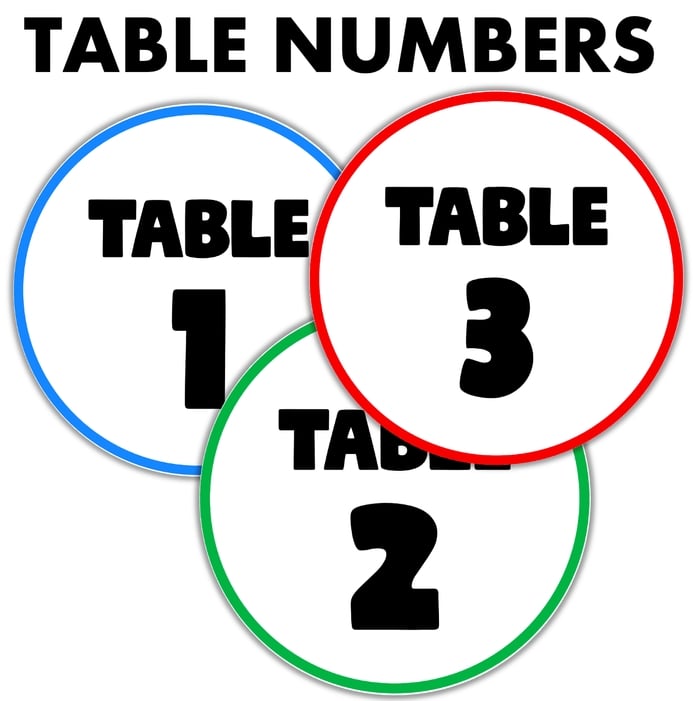
Labeling your student groups makes it easy to hand out points.
Here’s a set of simple table number cards I made to help you get started.
Download and print them from the Free Resource Library!
.
How to Introduce Table Points to Your Students
Introducing this system to students is actually kind of exciting because they usually can’t wait to start the “game” of earning points. Here’s how I roll it out at the beginning of the year:
Model It
Kids need to know what earns a point, what doesn’t, and what the points translate into for them. I like to make an anchor chart listing ways to earn points. Then we brainstorm examples of good behavior that are point-worthy. I talk explicitly about things like:
- appropriate voice level during centers
- working well in small groups
- cleaning up as a team
- making quick transitions
- helping group members
- showing kindness
- doing the right thing even when no one is watching
.
Emphasize Teamwork
I talk a lot about how every group member contributes to the team. If one student has a rough moment, it’s okay, it happens. We can encourage that person and bounce back as a team. I explain that sometimes our response to someone else’s bad moment is what earns a point.
An important note about how I implement my table points classroom management system – Points can be earned for the team even when we’re not working in groups. A student can earn a point for at lunch, while walking in line or working in centers, at teacher table – anywhere. The key is that good behavior, no matter where it happens, benefits the whole team.
.
Make the First Day Easy
I give points generously at first. Kids are motivated when they feel successful, so I focus heavily on catching them being awesome and doing a good job. I also want them to notice as many examples of good behavior as possible.
.
Table Points Classroom Management Day to Day
Once everyone knows the routine, table points become a natural part of our day. I like to award points liberally at certain times – transitions, group work, and right before dismissal. This is when bad behavior is most likely to pop up, so I want them to focus on EARNING points instead.
Here’s what this looks like on a typical school day:
Morning Arrival
When students walk in, unpack, and start their morning work without reminders, the team earns a point. This makes the morning so much smoother and gets the day off to a nice start.
.
During Instruction
I give points when groups participate respectfully, follow directions, or show teamwork. This is a great time to randomly catch students demonstrating positive behavior. For example:
- sharing materials with a student who forgot hers
- using whisper voices during a partner task
- being ready to learn with the correct supplies out
- active listening and keeping eyes on the speaker
- being supportive when someone answers a question incorrectly
- participating and staying focused
.
During Transitions
This is huge. Fast, calm transitions save a ton of instructional time. I make a big deal out of groups who move efficiently, push in their chairs, get out materials, and refocus quickly. Be sure you teach these procedures thoroughly so students know your expectations. After that, there’s really no reason transitions times should derail the day.
.
During Centers
This is another time of the day that I rely heavily on our table points classroom management system. During centers, I’m busy with my small groups, so it’s really important for the rest of class to be on task. Giving out a lot of points reinforces the good behavior I really need right then.
Here are some things I look for during centers to award points:
- Reading quietly without reminders
- Using the correct voice level
- Following our cleanup routine
- Staying engaged during independent work
- coming to teacher table quickly and prepared
.
Also, other teachers and service providers (like SPED, speech, or physical therapy) come in during our centers time. I invite them to give out table points too which creates consistency.
.
End of the Day
I always end the day with a class meeting. This is when we review important things that happened, talk about our successes, and maybe give out one last point if a particular group finished strong.
.
Weekly Recap
Depending on your class, you can announce the winning team at the end of the week or daily. For first grade and early second, daily works best. At that age, an entire week just feels too long. For students older than that, I prefer weekly because it builds anticipation, teaches patience and stamina, and cuts down on the time we spend on rewards.
.
How to Keep It Positive and Not Punitive
A common mistake teachers make (myself included, at least early on) is thinking table points are something to take away. While you technically can do that, I really encourage you not to.
Taking points away:
- damages the team atmosphere
- creates resentment within the group
- shifts the focus from success to failure
.
A table points system works better as positive reinforcement. This avoids the shame-based dynamic that some classroom management systems accidentally create.
.
Dealing with Individual Behavior Needs
You might be wondering: What if I have a student who really struggles to behave? Won’t their group always suffer because of them?
This is a totally fair concern. Here’s how I handle it:
Give More Points Than You Normally Would
When you give a lot of points, one off-task moment or problem behavior doesn’t ruin things for everyone.
Prompt Privately
If a student has individual goals or accommodations, prompt quietly or use subtle cues. Let the table earn points when the group works together to support that student.
Celebrate Growth
I like to give out “bonus points” for showing improvement. This gives students who normally struggle an opportunity to help their team even if their behavior isn’t perfect. During our weekly recap, I always recognize the “most improved” student and award that team extra points. This is so beneficial to those kids who are used to getting negative attention for their behavior and really helps build team camaraderie.
.
A Closer Look at Rewards
The goal with table points is not to bribe kids or spend a fortune buying prizes. The rewards should be meaningful but manageable. Here are some that’ve worked well in my room:
Special Privileges
These cost nothing and kids love them:
- sitting at the teacher’s desk
- choosing the line-up order
- using special supplies
- choosing a classroom job for the week
.
Interactive Rewards
A very motivating reward is to let the winning table group do something fun together. A mini STEM challenge, a quick game, or a special craft are some good ones.
.
Choice-Based Rewards
Kids LOVE choices. Sometimes a menu of simple options are the easiest way to handle rewards. Some ideas:
- stickers
- coloring time
- partner games
- sitting with a friend at lunch
- extra tech time
.
Tangible Rewards
You can absolutely use small treats and prizes like candy, pencils, bookmarks, or little toys – but use them sparingly. You don’t want your behavior system to turn into a weekly shopping spree. Plus, it costs a lot of money.
You can find more ideas for easy, no-cost rewards in this blog post:
.
.
Tips for Making Table Points Classroom Management Work All Year
Once you’ve used table points for a month or two, you’ll start to notice what works, what doesn’t, and what needs tweaking. Here are a few little things that I’ve found to keep it running smoothly all year long:
Change Table Groups Periodically
As the year goes on, personalities and group dynamics shift. Some groups become chatty, while others don’t seem to get along that well. Mixing up your teams every few months keeps things fresh and gives kids a chance to work with new friends.
Add “Surprise Point” Days
Sometimes I’ll announce, “Double-points day!” and the kids instantly snap to attention. It’s works like magic and is a great strategy for really challenging days (like right before spring break).
Let Students Help Update the Chart
Ownership is a powerful thing. Let a responsible student record points on your display chart or update the scoreboard.
Connect Points to Class Goals
Sometimes you end up with a class that really struggles with a particular behavior – maybe it’s tattling or whining or not completing homework. If you want to see class-wide improvement in that area, tie that goal to your points. Maybe each Friday, award extra points to the team that showed the most improvement.
.
Common Issues
Even a great system has hiccups. Here are some issues you might run into and how to fix them quickly.
Problem 1: One table dominates every week.
Solution: Shift up the types of opportunities offered. Some teams excel at academic behaviors, while others shine in transitions or kindness. Give a wider range of earning options.
.
Problem 2: Students focus too much on winning.
Solution: Keep rewards low-pressure. Make a big deal about growth, improvement, and teamwork rather than who earned the most points.
.
Problem 3: You forget to give points.
Solution: I’ve done this more than once! Some days just go off track and you forget. Set reminders, post your chart in an obvious place, and build it into routines (every transition, every cleanup, after each block, etc.).
.
Problem 4: Behavior slips after a school break.
Solution: Re-teach! After long weekends or holidays, review expectations, remind students what earns points, and give out extra points for several days to re-motivate everyone.
.
Ready to give it a try?
If you’re looking for the best way to create smoother school days, happier students, and a stronger classroom community, I cannot recommend table points enough. It’s a simple system, flexible, and most importantly, it actually works. I think it’s the most effective way to manage behavior positively without being overly complicated.
It gives you:
- a collaborative structure that builds teamwork
- a positive, encouraging tone to your day
- support for both behavior and academic goals
- a natural way to continuously teach expectations
- flexibility to use across subjects and activities
- a simple system that doesn’t require constant prep
.
Table points aren’t just for younger students either. Upper elementary kids crave structure, teamwork, and a sense of belonging, too. In fact, the older the kids are, the more they need to learn to work within a diverse group and get along with others. Learning to self-monitor behavior and work collaboratively are valuable lessons that they will carry into high school, college, and the workforce.
Whether you’re a brand new teacher learning the ropes, in your tenth year and needing a refresh, or simply hoping to make it through to retirement – this system can help you get there.
Maybe you’re at a point in the year where your classroom feels a bit chaotic, or maybe things just didn’t get off on the right foot in the first place – give table points a try.
Tomorrow morning, you can literally walk in, grab a piece of chart paper, assign your students to groups, and be ready to roll. No laminating. No printing. No clips or pocket charts, No hours of prep.
Just simple, effective, powerful points. It might just transform your classroom.