If you teach upper elementary, you might think the days of guided reading groups are over. But that’s far from the truth. Guided reading is one of the most powerful tools teachers can use to support literacy growth. It gives us the chance to slow things down and focus on what our students need most at that moment. This is especially important in third grade when expectations shift dramatically. So in this blog post, we’ll look specifically at guided reading in 3rd grade and how to make it work in your classroom.
.

.
Why Guided Reading in 3rd Grade Matters
In second grade and below, much of the reading block is spent learning to read – figuring out phonics, sight words, and how to get the words off the page. But in thrid grade, the focus becomes reading to learn – using texts to build knowledge, practice comprehension strategies, and tackle subjects like science and social studies. The texts used for reading change too – from short, simple texts to informational passages, complex stories, and even excerpts from news or science articles.
Not all students make the shift at the same pace, which is why guided reading is so valuable – it helps bridge the gap and gives every reader what they need. If we only ever teach whole group, it’s easy for some kids to get lost in the mix.
Small groups make it possible to zoom in on specific reading skills – like close reading, figuring out text structure, or using context to understand challenging vocabulary words – and give our kids the extra support they need to be successful. It’s also a time when you can step back to reteach phonics and fill in learning gaps.
.
Structuring Your 3rd Grade Guided Reading Block
In third grade, the reading block usually has a little bit of everything – some whole group lessons, time for kids to read on their own, and small group work. Guided reading happens during that small group time, often along with literacy centers or independent reading. While you’re working with one guided reading group, the rest of the class is still working on things that matter – maybe comprehension task cards, independent reading, practicing vocabulary, or writing responses to short stories. No time is wasted, and everyone’s learning.
But how do you make all of this happen? It’s not magic, but it does take a little bit of planning and a consistent structure. If you plan out how your reading block will look and stick to it, your students will learn the routine and your life will be so much easier.
Here’s how a 90-minute 3rd grade guided reading block might look:
- Whole Group (20 minutes): Introduce a specific reading skill, such as identifying the main idea or analyzing text structure, through modeling and shared practice.
- Small Groups/Guided Reading (45 minutes): Meet with two or three reading groups while other students engage in literacy centers or word work.
- Whole Group Wrap-Up (10 minutes): Revisit the day’s skill and connect back to the larger learning targets and reading goals.
- Independent Reading (15 minutes): Students apply strategies with self-selected texts.
.
This balance ensures all students receive both grade-level instruction and differentiated support.
.
Forming Reading Groups
I’ve always found planning reading groups to be a bit of a puzzle. Some third graders have barely gotten past leveled readers, while others are ready for more complex texts. Groups of 4 to 6 work best because you can really hear each student read and give support without losing anyone in the shuffle.
Remember, groups should be flexible, not permanent. You don’t need to make a list of who will be in each group for the entire year or even semester because it will change constantly. A student who struggles with informational text might be in one group for that unit but placed in a different group during your fables unit. You can use fluency checks, observations, or informal assessments to see what your students need right now and work from there.
The real trick is figuring out centers and how to keep students occupied while you meet with your groups. The length of your reading block and how many students you have are two things you can’t really change. If you have 30 students, your groups will look a lot different than a classroom with only 15 kids.
.

.
Here’s what I do to make planning my small group time easier – I set up enough centers for my whole class and then pull my groups from them, rather than trying to make teacher table its own center. This is what I mean:
Let’s say you have 24 students and you want no more than six kids working in a center at a time. That means you need four centers – so plan out four centers. Try to make them as low maintenance as possible. You might have a tech center, independent reading, task cards, and a book project.
Then sort your students into four groups for their centers. This does not need to be based on ability. In fact, it’s best to have heterogenous groups so all your high kids aren’t at one center while all your low kids are at another. Mix them up! They can support one another while you’re busy with your small groups. It’s better to group your students based on who works well together.
Next, plan out your guided reading groups – but don’t pay any attention to your literacy center groups. They don’t matter at this point. Just figure out which students need to be in which small groups this week based on whatever skill you’re teaching. Decide how many times you’ll see each group and for how long. You need to meet with your low kids every day if possible. For your high kids, twice a week is fine. But remember – these high/medium/low groupings are based on the current skill you’re teaching – not their overall reading level – so they will change regularly.
When it’s time for small group reading, send everyone to their first center. Then pull out whoever you need to see for your first small group. Yes, they will miss some of their center time, but so what? The whole point of small group time is to work with your students. Your centers are just the vehicle that allows you to do that. Once you finish with your first small group, send them back to their centers and call your next group over.
Your centers should rotate on a set schedule while your small group times are based on need. When your centers are set up this way, you have complete flexibility with your guided reading groups and it’s no stress!
✅ Teacher Tip: Don’t make your centers graded work. You will be pulling students away from them to meet with you, so they may not finish and that’s okay. Centers should be a time for students to practice skills and keep busy while you provide instruction.
.
Planning Your 3rd Grade Guided Reading Lessons
Now that you’ve figured out how to structure your small group time, you need to think about what you’ll do at teacher table.
Here’s an outline for a guided reading lesson for third grade students that works well:
- Preview the Text (3–5 minutes): Introduce the book or passage, point out tricky vocabulary words, and set a purpose for reading.
- Reading the Text (10–12 minutes): Students read—sometimes out loud, sometimes silently—while you listen in and offer quick support.
- Discussion and Comprehension Questions (10 minutes): Ask targeted questions and dig into a specific reading skill. Some of the main skills for third grade are identifying the main idea, analyzing character traits and motivations, or recognizing text structure like cause and effect.
- Word Work or Vocabulary Practice (5 minutes): Pull out a few key words from the text for practice to build vocab or practice spelling patterns.
- Wrap-Up (3 minutes): Connect the lesson back to bigger comprehension strategies, the thematic unit, or the week’s learning target.
.
This structure gives the lesson flow, keeps kids focused, and makes planning easier. Since your strongest readers for that week’s skill will need less support, their group time with you will be shorter, giving you more time to spend with the kids who are struggling.
.
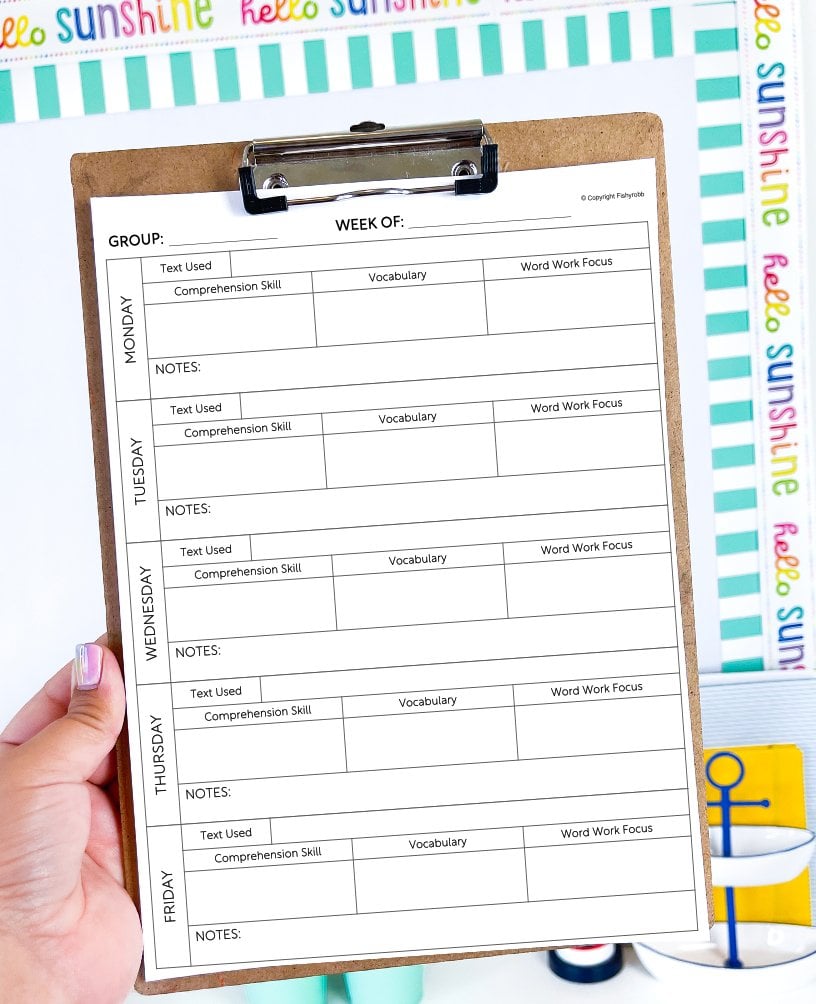
Planning your small group lessons can be time consuming without a consistent structure to follow. Find one that works for you and stick with it every week.
Here’s a simple small group lesson planning sheet you can use for guided reading in 3rd grade.
Click the image to download the printable PDF.
.
Choosing Texts
The books you choose for guided reading in 3rd grade really matter. A strong and rich guided reading collection should have a mix of different formats and genres, like:
- Short Stories: Perfect for teaching strategies like sequencing, main idea, or making inferences.
- Informational Articles: Great for integrating social studies or science content in English language arts
- Challenging Texts: Essential for close reading and building stamina.
.
A Note on Leveled Readers: These have been a go-to for years, especially systems like Fountas & Pinnell. But here’s the thing – relying only on leveled readers isn’t best practice anymore. Kids actually make more progress when they’re exposed to a wide variety of complex texts, not just ones that match their “level.” Leveled readers can still be useful, but they’re just a small tool in the toolbox.
Instead, picking books based on student interest can be even more powerful. When kids are excited about a topic, they’re more willing to stretch themselves, even when the vocabulary words are tough. That’s where we, as teachers, can step in to explicitly teach those tricky words in context.
For example, during a science unit on ecosystems, you might use an informational text about animal adaptations in your guided reading lesson plans. Along with practicing comprehension strategies, your kids will build background knowledge and get comfortable seeing new words they rarely encounter. Helping third graders navigate through challenging content-area passages prepares them for the rigorous texts they will encounter in higher grade levels.
If your reading curriculum doesn’t include a great variety of texts, I encourage you to check out some of the classroom magazine subscriptions out there. They give you an continuously new supply of reading material that most kids really love. Some of my favorites:
- Time For Kids
- Scholastic News
- National Geographic Kids
- Brainspace
- DIG Into History
.
Integrating Comprehension Strategies
Guided reading is the perfect time to practice comprehension strategies. With third graders, that might look like:
- Identifying the main idea and supporting details.
- Noticing text structure (like cause/effect or compare/contrast).
- Making inferences and backing them up with text evidence.
- Summarizing short stories or informational text.
- Asking and answering comprehension questions.
- Doing some close reading of challenging sections.
.
Try to choose activities that let students apply these strategies in different formats. A graphic organizer or character map is great for visual learners. Reading task cards and word sorts provide a hands-on component. Group discussions build critical thinking as students explain their reasoning and give them a chance to use their social skills. Varying your activities and using different formats keeps small group lessons engaging for everyone.
I love to use graphic organizers with my groups. They are really great for zeroing in on a specific skill or strategy, and they provide structure as students are learning – plus, I can easily see students’ thought process as they fill in their organizers. This is important because I want to intervene as soon as possible when a student needs help.
What’s great about graphic organizers is they turn abstract thinking into something concrete kids can see and talk about.
.

.
.
Here are some of my favorite graphic organizers to use during guided reading:
- Main Idea and Details Web: Great to use with science or social studies passages
- Story Map: Use with short stories to track characters, setting, problem, and solution. Third graders love drawing little icons or symbols in each box.
- Compare and Contrast Chart: If your group is reading two texts on similar topics, a simple Venn diagram helps them break down similarities and differences.
.
Whatever activity you choose for your groups, make sure you can easily check for understanding as students are working. A long written response isn’t something that works well in guided reading, but a short quick-write is totally appropriate. After finishing a story, ask students to write a one-sentence summary on a sticky note, or to jot down the most important vocabulary word from the passage and explain why it matters. This keeps accountability high and gives you an easy check-in.
.
Word Work and Vocabulary
Even in third grade, word work is still important – especially for kids in special education or those who need more decoding practice. A quick activity on prefixes and suffixes, multisyllabic words, or spelling patterns can make a big difference. It’s so much more effective to do this in small group than whole group, so I always include a few minutes for this in my lesson plan.
.

.
Word sorts are a quick and effective way to fit this in. Try things like:
- Sorting words by prefixes (re-, un-, dis-)
- Sorting by syllable types (open, closed, vowel team)
- Sorting base words with suffixes (-ment, -ful, -less) to see how meaning changes
.
Vocabulary words deserve just as much attention. Pull the most challenging ones from the text and teach them explicitly. Highlight the Tier 2 and Tier 3 vocabulary. If you choose texts based on your students’ interests, they’ll be more motivated to learn and use those words.
.

A simple Frayer model is great to use when introducting important vocabulary. I keep a supply of them at my reading table. Slip a few into dry erase sleeves and you can use them over and over.
Click the image to download a copy.
.
Special Education and Guided Reading in 3rd Grade
Guided reading time is a great opportunity to give extra support to your ESE students and work on IEP goals. The small group setting makes it easy to adjust instruction and work at a pace and level that works for them. Here are a few ways to adapt your small group instruction for your ESE students:
- Using lower-level texts when needed, without limiting exposure to grade-level content
- Spending more time on word work and decoding strategies
- Incorporating more graphic organizers and other visual aids to scaffold comprehension
- Breaking reading into smaller chunks for close reading
.
You can also incorporate some of the specific accommodations listed in the student’s IEP. Don’t forget to document the extra support you provide with an accommodations checklist.
.
Final Thoughts About Guided Reading in 3rd Grade
When you think about planning your reading block, don’t stress. Think of it as a wonderful opportunity to meet students where they are. At the end of the day, everything we do in 3rd grade is about getting kids ready for 4th grade. Guided reading helps them build stamina, expand vocabulary, and learn comprehension strategies that carry over into every subject.
Here’s what quick checklist of how you can make the most of guided reading in third grade:
- Keep groups flexible and based on ongoing assessment.
- Plan lessons that mix reading, discussion, word work, and comprehension.
- Use a wide variety of texts – not just leveled readers.
- Pick books that interest kids and build content knowledge so you can teach challenging vocabulary in context.
- Bring in different formats like graphic organizers, task cards, and close reading activities.
- Connect reading lessons to thematic units in social studies or science.
- Adapt instruction for special education needs.
.
Guided reading isn’t just about reading the book in front of you. It’s about building a reader’s development, and preparing them to take on the tougher texts and skills ahead. Done well, it’s one of the most powerful teaching tools we have.