Fake reading – If you’ve ever sat across from a student during independent reading time and watched them flip through books aimlessly, you know what I’m talking about. There’s always a kid or two who’s an expert at “reading while not actually reading”. Then there are a few more who might actually be registering the words on the page, but they just aren’t into it. More often than not, these are the students we have – not the enthusiastic readers, devouring book after book, that we dream of.
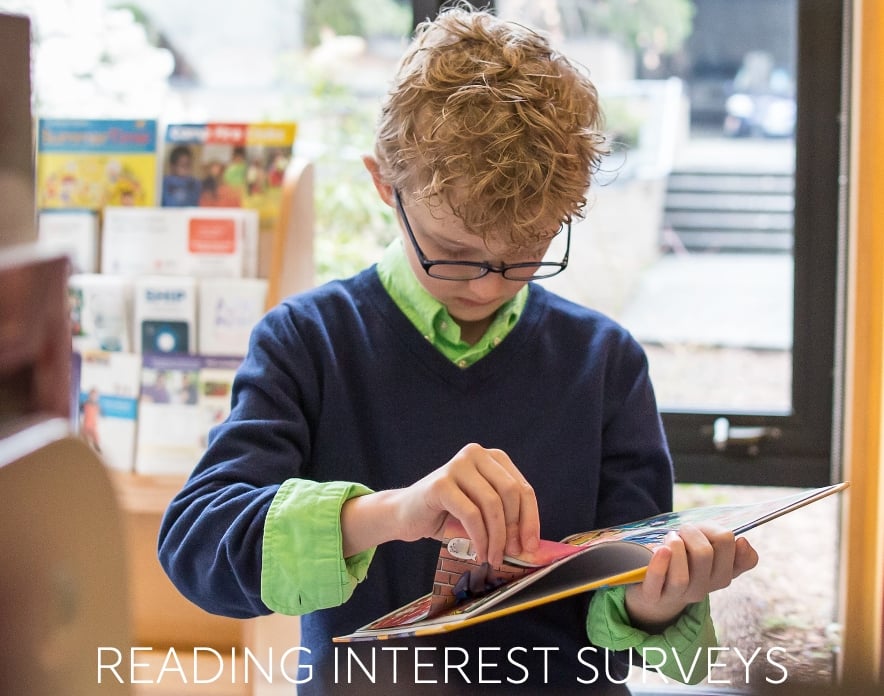
But all is not lost! I have a tip to get our kids – even the “fake readers” – to feel excited about books and actually look forward to reading time. Use a reading interest survey! It’s a simple tool that has made a world of difference for me.
.
.
Today, I want to share exactly what a reading interest survey is, why it matters so much for our students (and for us as teachers), and how to actually use one in your classroom without adding more stress to your already packed schedule.
✅ I’ll also give you a free printable reading interest survey for elementary kids that you can use right away!
In this post, I’ll walk you through:
- What a reading survey is and why it works so well with elementary school students
- The different types of surveys you can use to get the information you need
- The best reading interest survey questions to ask
- How to use the survey data to support individual students and whole-class instruction
- Tips for using surveys with both younger students and upper elementary students
- And of course — a link to that free reading interest survey you can use right away
.
So grab a cup of coffee and settle in, because this is one of those strategies that’s easy to implement and pays off in a big way. Let’s dive in!
.
What Is a Reading Interest Survey?
A reading interest survey (sometimes called a reading interest inventory) is basically a short questionnaire that helps you find out what your students like or dislike about books and reading. It asks them about their reading interests and behaviors. Think of it as a sneak peek into their reading personalities.
Surveys could include:
- Questions about favorite books
- Questions about genres and the types of books they enjoy most
- Prompts about reading choices during free time
- Questions about students’ attitudes toward reading in general (love it, like it, it’s just okay, avoid it at all costs)
.
You can make your survey as simple or as detailed as you want. For younger students, it might include checkboxes with pictures of animals, sports, and adventures. For upper elementary students, your survey can include open-ended questions about their most recent good book or new books they’d like to see added to the classroom library.
What I love about a reading survey is that kids genuinely like them. They get to talk about themselves and their interests. And that helps you, too, because it lets you see the whole child as a reader.
.
Why Use a Reading Interest Survey?
You already have a million things to do during the first weeks of school. So why add one more paper to your stack? Because this one unlocks so much potential and will actually make the rest of your year a lot easier.
Here’s why reading interest surveys are so valuable:
.
1. You Get to Know New Students Quickly
During the first week of school or at the beginning of the year, you can hand out a one-page student survey and, in less than 15 minutes, collect a goldmine of valuable insight. You’ll know which kids love sports, which kids read comics, which kids adore animals, and which kids say they “don’t like reading” at all.
Instead of guessing, you’ll immediately have a clearer picture of your students’ reading habits and preferences. That information can be a great way to reach those reluctant readers who aren’t motivated by grades but are motivated by a topic they love.
.
2. You Can Match Students With the Best Books
We’ve all had the “I don’t know what to read” kid. A reading interest survey gives you a cheat sheet for matching them with a book they’ll love.
- A child checks “funny” → You hand them Diary of a Wimpy Kid.
- A student circles “science” → You steer them toward the nonfiction books in the school library.
- A child lists “art” as one of their favorite things → You recommend a picture book full of vivid graphic arts
.
Suddenly, they’re not just reading because they have to.
.
3. It Builds Relationships with Students
When you ask kids about their interests and honor students’ needs, they feel like their feelings and opinions matter. That sends a powerful message: I care about you as a person, not just as a reader. Kids light up when they realize you’re taking the time to learn what they enjoy outside of school.
I’ve had students who rarely spoke in class suddenly open up just because I asked about their favorite video games or sports teams on a reading survey. That connection is gold.
.
4. It Supports Differentiation and Small Group Instruction
Not all readers are the same—and not all kids are motivated by the same things. A survey helps you differentiate reading experiences, whether that’s book choice, reading groups, or even projects.
For example, two students might be on the same reading level, but one loves mysteries and the other loves sports. By knowing their preferences, you can provide texts that appeal to both while still targeting the same skill.
Because surveys act as an informal assessment, they’re incredibly useful for planning instruction. You can form small groups around similar interests (like fantasy or science) or start book clubs for kids with common tastes.
This can make a big difference in engagement during independent reading time and group work.
.
5. It Creates a Classroom Culture of Choice and Lifelong Learning
Kids crave ownership. They’ll be more invested when you let them have real input into what they read at school. It’s a small step toward building a classroom culture where reading is seen as personal, enjoyable, and meaningful—not just another assignment.
.
Different Types of Reading Surveys
Not every class — or child — needs the same format. Here are different types of surveys to consider:
- Paper-Based Surveys
- Digital Surveys
- Task Card Surveys
.
Paper Surveys
Paper surveys quick, easy, and flexible because you can adapt them to your particular class. Find a pre-made survey online (or at the end of this blog post!), print, and use. A paper survey is nice because you can save them in your students’ portfolios or whip them out during parent conferences to share with families.
Digital Reading Interest Surveys
A digital version is a great tool if you don’t want to deal with a bunch of paper surveys. Using Google Forms or another platform, you can let students fill out their questionnaire during your usual tech-time. If you already have a paper survey you like, it’s pretty easy to just type it into a Form.
Task Card Surveys
Instead of giving your class a page full of questions to answer, split them up onto task cards and set up a Scoot activity. This gets them up and moving around and makes the whole experience more interactive. Any survey can be adapted to task cards, but this option does take a bit more work.
.

.
Creating a Reading Interest Survey That Works
This doesn’t have to be complicated. But to get the most out of your survey, you’ll want to design questions that fit your students.
Young Learners
- Use visuals, not just words. Picture-based questions let students circle or color their choices.
- Keep surveys short (5 multiple-choice questions is plenty).
- Focus on broad categories like animals, sports, or funny stories.
- Make the process fun — almost like a game. You can even set up your questions as a Kahoot!
.
Grades 2 to 3
- Use mostly multiple-choice questions with just a couple of short responses.
- Focus on the topics they enjoy, their favorite reading spot, hobbies, and their feelings about reading in general.
- 6-10 questions are enough for this age group.
.
Upper Elementary Students
- Expect more detailed responses.
- Include some open-ended questions. Kids this age love to express their opinions, so don’t box them in with all multiple-choice.
- Ask about favorite authors or genres, and their attitudes toward reading outside of school assignments.
- Invite them to suggest new books or genres for the classroom library.
.
Best Reading Interest Survey Questions
Here are some of the best reading interest survey questions you might use. These work well for most elementary school students, but you can adjust based on age. Remember, the younger your students, the shorter your survey should be.
- What is your favorite TV show, movie, or game?
- What are some of your favorite things to do in your free time?
- What kinds of books do you like (funny, scary, adventures, true stories, sports, mysteries)?
- Who is your favorite character from a book or show?
- Where is your favorite place to read?
- Do you like to read alone, with a friend, or with an adult?
- What is the last book you really enjoyed?
- Can you think of a book you really disliked?
- How often do you read just for fun or in your free time?
- Do you have a favorite author?
- What’s something you wish there were more books about?
- How do you feel about reading right now (love it, like it, it’s okay, not my favorite)?
.
Using Survey Data
Surveys are only useful if you actually use the information you collect.
- Small groups: Plan targeted lessons using reading material that kids already have a strong interest in.
- Book clubs and Reading Partners: Group kids with a shared interest and let them read and discuss a book on that topic.
- Classroom library planning: Use surveys as a shopping list for new books. Stock more of what your kids want.
- Parent communication: When conferencing with parents, share what you’ve learned (“Your child loves mysteries. Here are some books to get them reading at home.”)
- Track changes: Repeat surveys mid-year. Seeing shifts in students’ reading attitudes is itself valuable insight.
.
Free Reading Interest Survey for Elementary Students
.
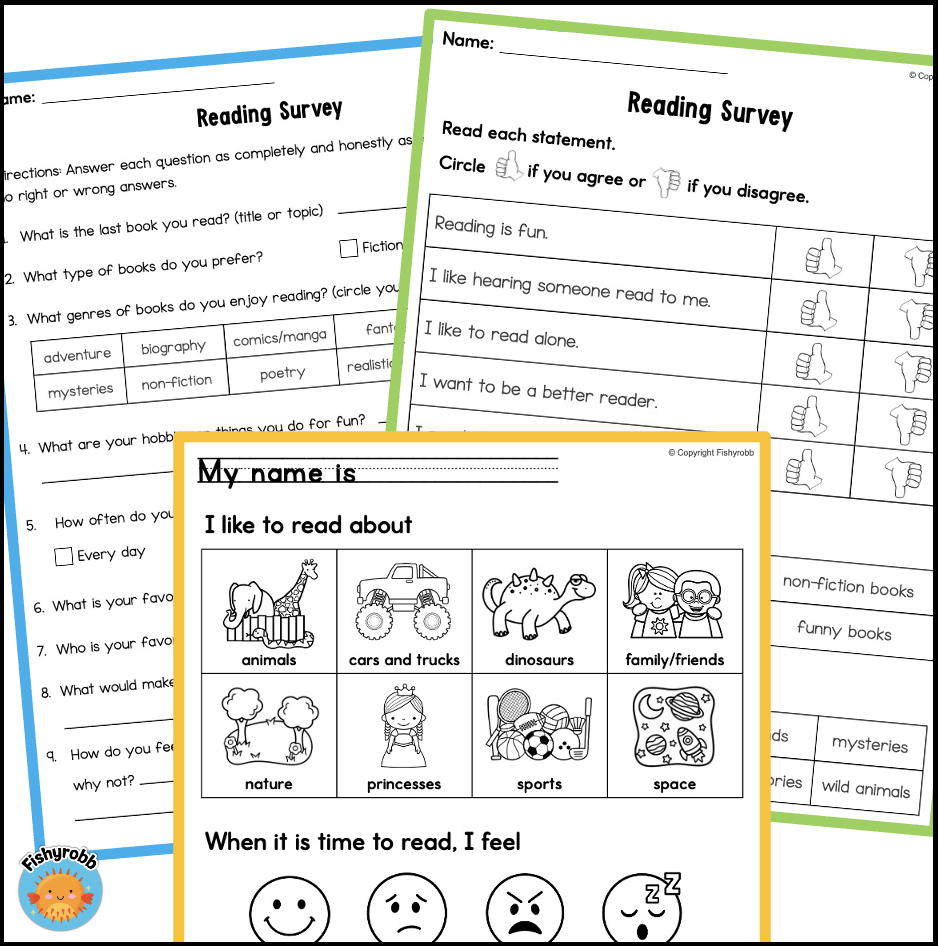
To save you some time, I’ve created a few free printable reading interest surveys you can use right away.
- K to 1: Picture-based survey
- 2 to 3: Multiple-choice survey
- 4 to 5: Open-response survey
.
You can grab all three of them from the Free Resource Library. Feel free to share with a teacher friend, too.
.
A reading interest survey is one of the simplest and most effective tools for understanding your students, especially at the beginning of the school year when you really don’t know them at all.
With just a few minutes of prep, you’ll be able to:
- Recommend the best books for individual students
- Build a well-rounded and inviting classroom library
- Run more engaging book clubs and small groups
- Support even the most reluctant readers
- Show kids that their opinions and feelings matter
.
At the end of the day, it’s not about the survey itself — it’s about what it represents. When you take the time to learn about your students as readers, you are helping them discover the joy of finding that special book — the one that changes everything. And that’s the real start of a lifelong love of reading, which is our real goal as teachers, right?