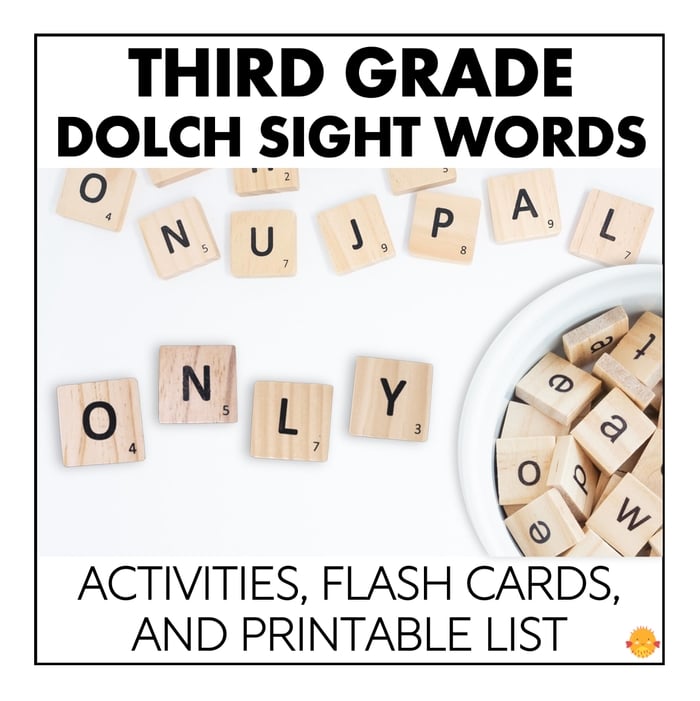
If you teach primary grades or have a child in kindergarten to third grade, you probably know all about the Dolch sight word lists. Many schools use these lists in their reading curriculum. They’ve been around forever and haven’t changed much at all. That’s because they’re full of the most frequently occurring words in children’s books – the words your kids see over and over again when they’re reading. Today, I want to chat specifically about the 3rd grade Dolch sight words and share some helpful tips (and free flash cards) that make learning them a little easier.
.
.
Why Sight Words Matter
If you have a 3rd grader, or teach them, you might think, “Aren’t we past learning sight words?” Well yeah, kind of. When kids are learning to read, there are some words they just can’t easily “sound out.” Words like again, said, or does don’t follow phonics rules. This can be a problem when there is such a heavy emphasis on phonics and the Science of Reading. So, we also have to teach sight words to fill in where phonics doesn’t work. These are words students need to recognize automatically, without having to stop and decode.
Why is this so important? Because fluent readers don’t stumble over or sound out every little word. Once kids know these common words instantly, their brains are freed up to focus on meaning or decode other words in the text.
.
Sight Words vs. High-Frequency Words
The terms “sight words” and “high frequency words” are used almost interchangeably, but they aren’t exactly the same thing. There’s an important difference, which can be really helpful to know when planning lessons for your class or working with your child at home.
- Sight words don’t follow regular phonics patterns. They are words that kids are expected to recognize instantly by sight because they can’t be sounded out accurately.
- High-frequency words are the words that pop up most often in print. They could be phonetically irregular words (sight words), or simply a very common word that kids see a LOT.
.
Even though many high frequency words can be sounded out, it’s better to just learn them by sight for reading speed and efficiency. If it’s a word you’re going to encounter over and over again, why not just memorize it, right?
The Dolch sight word lists combine both of these ideas. They are made up of high-frequency and sight words, all considered to be “service words” or “function words” (adjectives, adverbs, verbs, pronouns, etc.) There is also a special Dolch list of high-frequency nouns that are particularly common in children’s books. So those are good to learn too.
Dolch lists are organized into groups by grade level based on how often they appear in books. The more often they are used, the earlier they are taught. Each list is then put into alphabetical order. This is slightly different than Fry sight words which are simply listed in order of frequency. Fry words also include nouns throughout.
.
Dolch Word Lists by Grade Level
The Dolch lists are broken into sections by grade. Here’s a quick breakdown:
- Pre-Primer and Primer: 40 of the most basic words, often taught in kindergarten (sometimes even pre-k); words like a, me, the
- Primer: 52 words, also mostly taught in kindergarten (that’s a LOT of words for 5-year olds to learn)
- 1st Grade: 41 words
- 2nd Grade: 46 words
- 3rd Grade: 41 words
- High-Frequency nouns: 95 words
.
What’s in the 3rd Grade Dolch Sight Words List?
The 3rd grade Dolch words list contains 41 words. What you’ll notice about this list is that some of the words are really, really easy. For example, the words hot and ten are words that most kindergarteners can read. So why would they be an expectation on the third grade list? Well, like I said, Dolch created these lists based on how frequently the words appeared in books. So hot and ten didn’t appear nearly as frequently as the words on the first grade or second grade lists.
The good news is that out of the 41 words on the 3rd grade Dolch sight words list, nine of them are ones your child or students almost certainly know by now or can read with nearly no effort. If that’s the case, you can cross them off and focus on learning the others.
Here are the 41 words. I’ve underlined the ones that probably don’t need to be practiced (but it’s okay if they do):

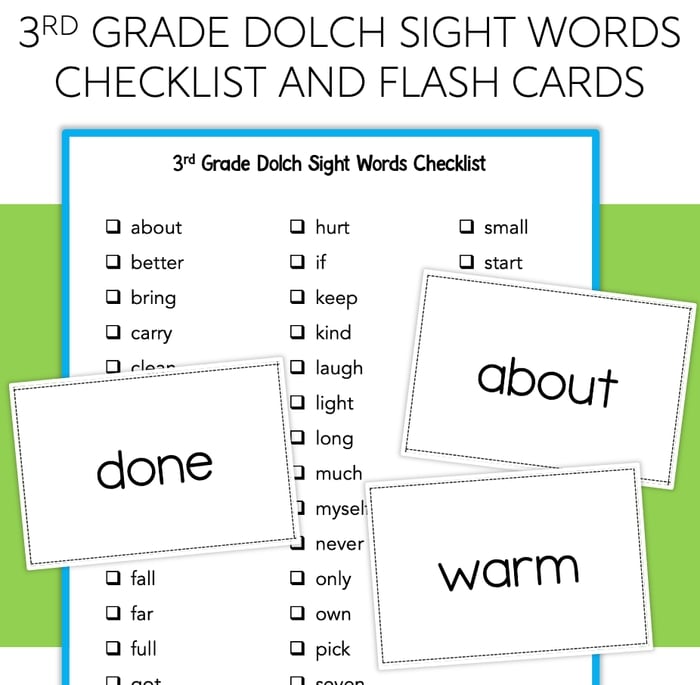
If you’d like to keep these words on hand to practice with your students or child, I’ve got a couple of PDF files for you. One is a set of flash cards that can be used for drills or games. The other is a list of sight words that you can use as a checklist to keep track of which words have been mastered and which need more work. You can download both from the free resource library:
.
.
Fun Ways to Practice 3rd Grade Dolch Sight Words
Flashcard drills can get pretty boring, but there are a lot of other ways to sight word activities that utilize your basic set of sight word cards. Here are a few simple ideas that 2nd to 3rd graders love:
Sight Word Bingo
Make simple bingo boards using the word list. Call out the words, and kids can mark them on their bingo board with counters or little candies (Skittles or Smarties work great). This can be done in small groups or as a whole-class activity.
.

Need a blank bingo card template for your sight word games? You can grab one in this blog post:
Classroom Bingo – A Fun Way to Practice Math and Reading Skills
.
Memory Match
Print two sets of sight word flash cards. Lay them out face-down like the classic memory game. Kids turn over two at a time, trying to find matches while reading the words aloud.
Sight Word Go Fish
This is a fun small group activity. You’ll also need two sets of sight word cards for this game that’s played just like traditional Go Fish.
Deal out five cards to each plalyer (two to four kids). Place the rest in a “draw pile” in the center of the table. Players take turns asking another player for a specific sight word. If they have it, they must give it to the asker who keeps them as a “match.” If not, the player says “Go Fish!” and the asker draws a card from the pile. Keep playing until someone gets matches for all the cards in their hand.
Flashlight I Spy
This can be a large-group activity or you can play with just your own child at home.
Tape sight words around the room. Give each child a flashlight and turn off the overhead lights. Call out a sight word (I spy the word “____”). Students turn on their flashlights to “find and read” the word you called out. This activity produces a lot of giggling and carrying on, so you might want to make a “silent game” rule.
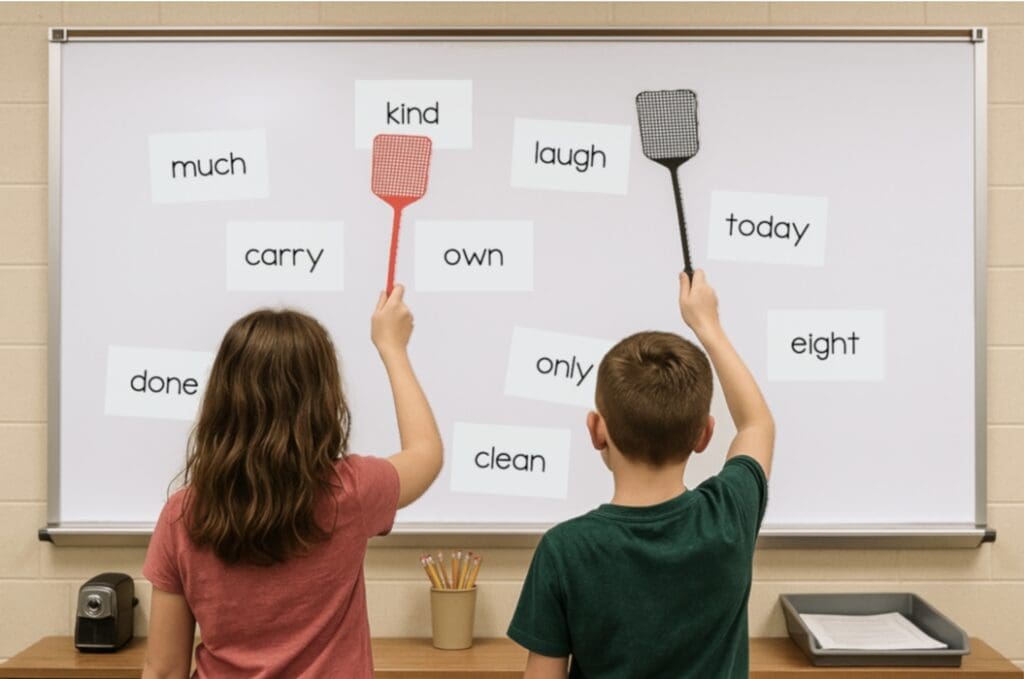
Sight Word Swat
Write a set of high-frequency words on sticky notes or index cards. Scatter them on the floor or tape them to the wall. Give two players fly swatters. Call out a word and watch them race to swat it first.
If you’re a classroom teacher, hang the words on your board (or write them spaced apart). Split the class into two teams and have them line up on either side of the room. Have the first person in each line come up to the board to swat the word you call out. Whoever swats it first gets back into their line. The other person sits down. Keep playing until one team has won.
.
.
Learning sight words doesn’t have to be just reading a list over and over. It’s about regular exposure until reading the word becomes automatic. Anything that gets them in front of kids will help build that word recognition.
.
When Should Kids Master 3rd Grade Dolch Sight Words?
Here’s a little secret: Even though there is a “third grade” list, most schools have taught these words by the end of second. In third grade, students are expected to have them down pat. Teachers want their students focused on comprehension and vocabulary, not tripping over sight words.
But that doesn’t mean third graders shouldn’t keep practicing them. I’ve had plenty of students who needed review all through the year. My goal was to make sure all of them knew all their sight words really well before heading off to 4th grade.
So, if your second grader has mastered the 2nd grade Dolch sight words and is working through the 3rd grade list, that’s right on track. And if your third grader still needs a little extra practice? No worries. Just keep practicing and keep it fun.
Sight words might seem small, but they have a big impact on reading fluency – which in turn, has a big impact on comprehension. They really are a building block for reading success.