

If you teach upper elementary (3rd, 4th, or 5th grade students), you know how exciting – and sometimes challenging – teaching figurative language can be. In today’s blog post, I’m sharing some tips and ideas for teaching this topic in a way that helps kids truly understand what figurative language is, use it in their own writing, and deepen their reading comprehension.
Why Teaching Figurative Language is Important
Before we dive into specific strategies, let’s talk about why we bother teaching figurative language at all.
Kids encounter figurative language all the time – in picture books, popular songs, poetry, and even TV shows – but they don’t always recognize them. A lot of times, kids just skim past unfamiliar figures of speech instead of trying to understand them. That’s unfortunate, isn’t it?
That’s why we need to teach all kinds of figurative language like idioms, similes, metaphors, hyperbole, and personification. When our students can move beyond the literal meaning of words, it opens up a new level of reading comprehension and even conversation skills.
And when kids start using figurative language in their own writing – well, that’s the icing on the cake! 🍰
Figurative language makes writing more expressive and imaginative. Instead of “The dog ran fast,” they write “The dog raced like a bullet across the yard.” Not only is their writing better, it’s a whole lot more enjoyable for you to read and grade.
So, let’s look at 5 tips that make teaching figurative language more effective:
.
Step 1: Introduce Literal vs. Figurative
The logical starting point (especially for 3rd grade students) is to build a firm understanding of literal versus nonliteral. Many kids will hear idioms or metaphors in conversation without knowing why they don’t make sense. Explicitly teaching what nonliteral language is really helps.
Mini Lesson:
- Write two sentences on the board:
- “I’m really hungry.”
- “I’m so hungry I could eat a horse.”
- Ask which one could really happen.
- Let them discuss (and laugh) and then explain that the second sentence is figurative – it uses words in a creative way to describe being very hungry.
- Create an anchor chart labeled Literal or Figurative? Fill it with examples the class creates together.
.
Extend: Have students apply this learning with a small group sorting activity. Give groups a mix of literal and figurative phrases to sort into two columns.
Wrap Up: Kids love coming up with wild “literal” pictures to match common sayings. Playing “Figurative Language Pictionary” is a really fun way to work this into your lesson. Write well-known figurative phrases on index cards. Pass them out and let students come up and draw the literal meaning. The rest of the class tries to guess the figure of speech.
.

.
This simple, interactive mini lesson builds a strong foundation for later.
.
Step 2: Introduce the Main Types of Figurative Language
Once students understand the difference between literal and figurative, the next move is to teach the different types of figurative language (or at least the ones you’ll target in your unit).
Here are the main ones I recommend covering in grades 3 to 5:
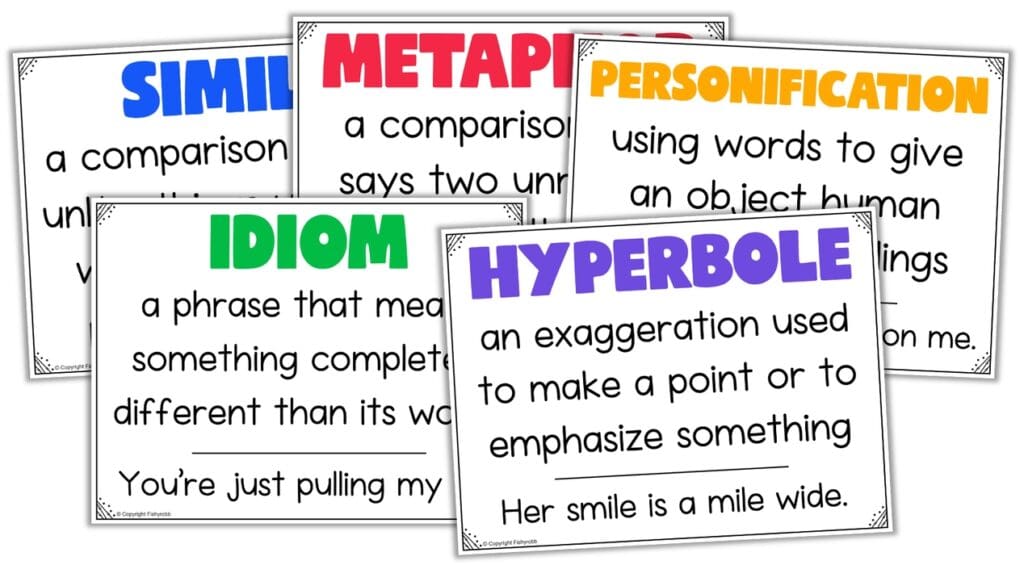
- Simile: a comparison using “like” or “as”. Example: Her smile was as bright as the sun.
- Metaphor: a direct comparison that says one thing is something else. Example: The classroom was a zoo on the last day of school.
- Idiom: a phrase that doesn’t mean what the words literally say. Example: Don’t spill the beans!
- Personification: giving human qualities to non-human things. Example: The wind whispered through the trees.
- Hyperbole: an extreme exaggeration for effect. Example: I’ve told you a million times to clean up your room.
.
When teaching each type, I always start with: definition + simple examples + anchor chart visuals + guided practice
A big anchor chart with definitions and examples of each is an effective way to keep them visible for reference all year. Use colorful headings and even student illustrations to help solidify understanding.
.
.
How about some FREE figurative language printables? Grab these simple anchor chart posters in the resource library:
.
.
➡️ Teacher Tip: Don’t overload your students with every kind of figurative language at once. Teach one or two at a time.
I like to start with hyperbole because it tends to be the easiest to understand. Then, I teach similes and metaphors together because they are so similar. It’s easy to teach kids to change a simile into a metaphor by swapping a few words. Idioms are last on my list because they are the most difficult to understand, especially for ELL students.
.
Step 3: Use Mentor Texts for Teaching Figurative Language
One of my favorite ways to teach this standard is through mentor texts. Picture books, short stories, poetry, even song lyrics are full of figurative language. I love using mentor texts because 1) everyone loves read alouds and 2) kids get to hear figurative language in context which is super important.
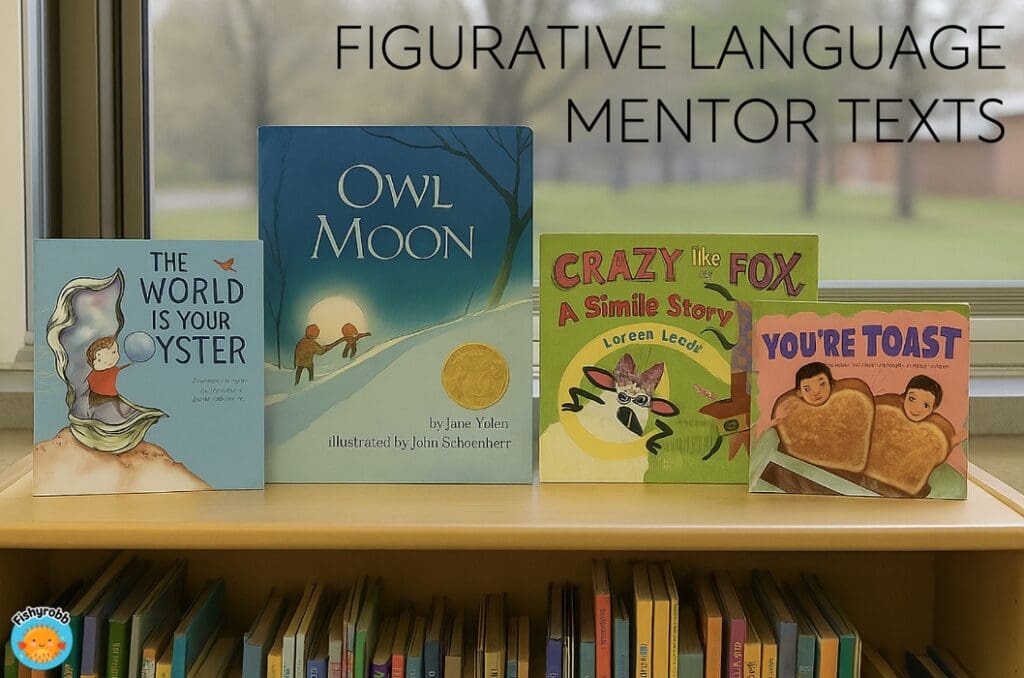
Here are a few of my favorite mentor text books for teaching figurative language:
.
.
Owl Moon
This is my first pick because you probably already have it in your classroom library. If not, you will certainly find it in the school media center or a colleague’s room. Owl Moon by Jane Yolen is an excellent mentor text for teaching figurative language because it’s packed with examples of similes, metaphors, and personification:
- The moon made his face into a silver mask.
- The trees stood still as giant statues.
- A train whistle blew, long and low, like a sad, sad song.
- I was a shadow.
- The snow was shining like bleached flour.
.
The World Is Your Oyster
If you’re teaching idioms, this is your book. The entire story is written in figurative language, and the illustrations are literal representations, which makes it very entertaining for upper elementary kids. Phrases like “Take the bull by the horns” and “Someone’s got your goat” are hilarious when drawn exactly as they sound. I love using The World Is Your Oyster as an introduction to idioms!
.
You’re Toast
For metaphors, I highly recommend You’re Toast by Nancy Loewen. The story brings common sayings to life by showing what they might look like if they were real. This is another book your third, fourth, or fifth graders will get a good laugh out of.
.
Crazy Like a Fox
Crazy Like a Fox by Loreen Leedy is perfect for teaching similes. The main character, Rufus the fox, gets accused of stealing a pie, but he uses his wits to prove his innocence. The story is a great mentor text for showing how similes can build character and tone.
.
Before you begin reading one of these mentor texts, let students know what they’ll be listening for. They can jot down examples as you read. After reading, add their ideas to an anchor chart and discuss.
Extend: Break students into small groups to scan the text again and look for additional examples of figurative language. Have them create a poster with their favorite figurative phrase and a literal illustration (which can be very funny). This is a great way to promote collaboration and deeper thinking.
Wrap Up: Afterwards, invite students to share their posters with the class and explain the figurative meaning. Encourage discussion about how the author’s choice helped create vivid imagery or a certain mood.
.

.
Using read-alouds for teaching figurative language ties in reading comprehension, vocabulary development, and writing skills.
.
Step 4: Independent Practice
Once students are familiar with the types of figurative language, it’s time for some structured practice. This is when I bring out my task cards, hands-on centers, and partner activities. Here are a few ideas you can use:
- Create or use a set of task cards with short sentences or phrases containing figurative language. These might ask students to identify the type of figurative language, explain what the author meant, or rewrite the sentence in a literal way.
- Use sorting activities: Have students sort cards into types of figurative language (idiom, simile, metaphor, personification, hyperbole). This is great for partner or small group work.
- Use small groups to work on more complex mentor-text snippets: “Here’s a passage with multiple figurative language examples. Highlight them, decide what type they are, and discuss why the author chose them.”
- Use popular song lyrics or poetry and have students hunt for various types of figurative language. You can even set up listening stations and have students rotate through them – listen to a song, jot down the figurative language they hear, and then move on to the next station. Fifth graders love this one!
- Create a scavenger hunt by placing different texts around the room (picture books, poems, song lyric sheets, etc.) Give students a recording sheet and let them search the room to find and classify figurative language. This is a fun way to keep things moving and interactive.
.
Step 5: Start Writing
Identifying figurative language is only half the battle. The other half is getting students to use it in their own writing. That’s when you know they’ve really got it! But writing can be one of the most difficult ELA skills for many students, so you’ll definitely want to include scaffolding in your lesson plans.
Here’s how I do that:
- Provide a writing prompt that explicitly asks for figurative language: e.g., “Write three sentences about a storm arriving that include at least one simile, metaphor, or personification.” Then have them partner-share and identify each other’s use of figurative language.
- Next, give students a pre-written descriptive paragraph. Ask them to revise it by finding places to add a figure of speech. Encourage them to ask: Where could I create more vivid descriptions? Where could I use a comparison or apply a human trait to something inanimate?
- Display a picture prompt and have students generate their own descriptive paragraphs using figurative language. I like to put up a scoreboard with points for each type – 1 point for a simile, 2 for a metaphor, 5 for an idiom, etc. This makes a good collaborative small-group activity.
- After initial writing, challenge students to rewrite a piece by replacing the figurative language with a different example of figurative language. Have them partner-share to answer prompts like “How did the change affect the image or the mood?” This is a good extension activity for 5th graders.
.
Make sure to celebrate your students’ efforts here. An easy way to do that is by putting up a “Figurative Language Wall” to display outstanding student work. Most of all, have FUN because that’s what figurative language is!
.
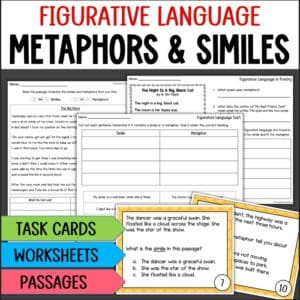
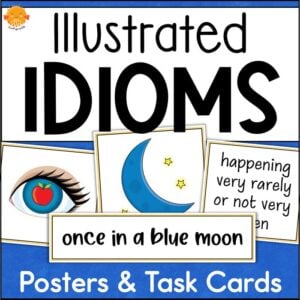
Ready to dive deeper into teaching figurative language? Check out these ready-to-go resources for third to fifth grade: