If you teach first or second grade, I bet you’ve put some thought into how to teach odd and even numbers. You also probably already know that it’s more than just covering a basic concept with a quick mini-lesson. For young children, the fact that some whole numbers “pair up” and some don’t is an important idea that shows up everywhere – sharing snacks, building arrays, splitting the whole class into teams, and later in multiplication and division. The good thing is that there are plenty of fun and easy ways to make this math concept stick.
.
.
How to Teach odd and Even Numbers
Here are six of my favorite strategies to help first and second graders, or even older students, recognize and understand odd and even numbers.
.
1. The “Odd Man Out” Test
Ask a student how to tell whether a number is odd or even, and chances are they’ll say, “Even numbers have partners.” And they’re right! If everyone has a buddy, the number is even. If one gets left out, it’s odd.
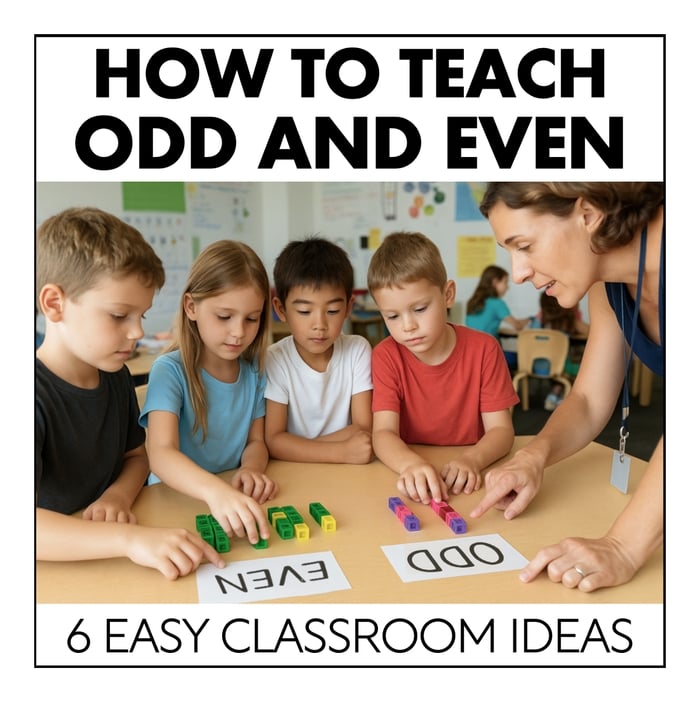
To introduce this idea to your class or child, all you need are some counters, cubes, or even everyday objects like crayons. Start with a pile of 10 and pair them one by one. Ask, “Does everyone have a partner? Yep, so 10 is even.” Then try it again with 11, but let students do the pairing to discover the leftover piece. Keep going with various numbers until they start to see a pattern.
If you have students that struggle with this, give them an empty egg carton and have them sort objects (jellybeans are fun!) into the egg cups – one in each. This will help them see if there’s a lone leftover more clearly.
Once kids get the idea, you can start connecting to place value. If 10 is always even, what about 20 or 30? It gets them thinking about hundreds and tens as groups.
Why it works: The physical act of pairing forces students to connect the abstract idea of “evenness” to fairness and equality, concepts they already understand socially.
Teacher tip: Don’t rush. Ask kids to predict before you reveal the answer. “Will 15 be even or odd? How do you know?” That prediction piece strengthens their number sense.
Extension: Move to larger sets. For example, try 24 counters, but ask students to split it into tens and ones before pairing. If they know ten is always even, they only need to think about the ones. This helps move them toward understanding even and odd with large numbers without needing visual models.
.
2. Even and Odd Towers
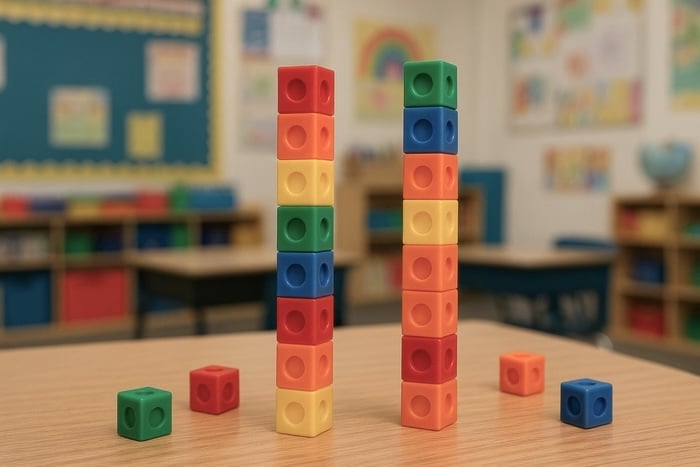
For your stations or small groups during guided math, try building odd and even towers together. This center is a fun way to explore this important skill. I love it because it’s self-checking and kids can actually SEE the answer.
Students pick a number card, build a tower with that many unifix cubes, and then physically break it into two stacks. If the stacks are the same height, the number is even. If one is taller, the number is odd. The immediate feedback is so important, and they love proving the answer for themselves.
.
.
Why it works: It’s a concrete representation, which is great for young learners and students with learning difficulties. The act of snapping cubes apart into two groups isn’t random. Kids actually have to use some problem-solving skills to determine where to break them. This quietly builds background knowledge that will help later on with division and fractions.
Teacher tip: If you’re using this as a math center, have students record their results on a simple t-chart (Number / Even or Odd). This adds some accountability and doubles as a formative assessment quick check.
Extension: To start working on early multiplication concepts in 2nd grade math, have students build towers that represent multiples of 2, 3, 4, etc. For example, build 12 and check how it splits evenly into 2s, 3s, or 4s. Ask: “Is 12 still even when we look at groups of 3? Why or why not?”
.
3. The Last Digit Rule
After lots of hands-on practice, your students will be ready for a shortcut. You can’t pull out blocks and match them up all the time, right? Now is the time to teach them that the ones place holds the answer.
Odd numbers end in 1, 3, 5, 7, or 9. Evens end in 0, 2, 4, 6, or 8. Let them test it a few times with manipulatives to be sure. But once they see that it’s true every single time, they can rely on the rule when evaluating numbers.
On a big anchor chart, draw two columns labeled “Even” and “Odd.” Fill in 0 to 9 which should be pretty easy at this point. They’ve been practicing those numbers a lot. Then move to 2-digit numbers. Circle the number in the ones place and say, “We don’t care how many tens there are because groups of ten are always even. We only need to worry about the ones now.”
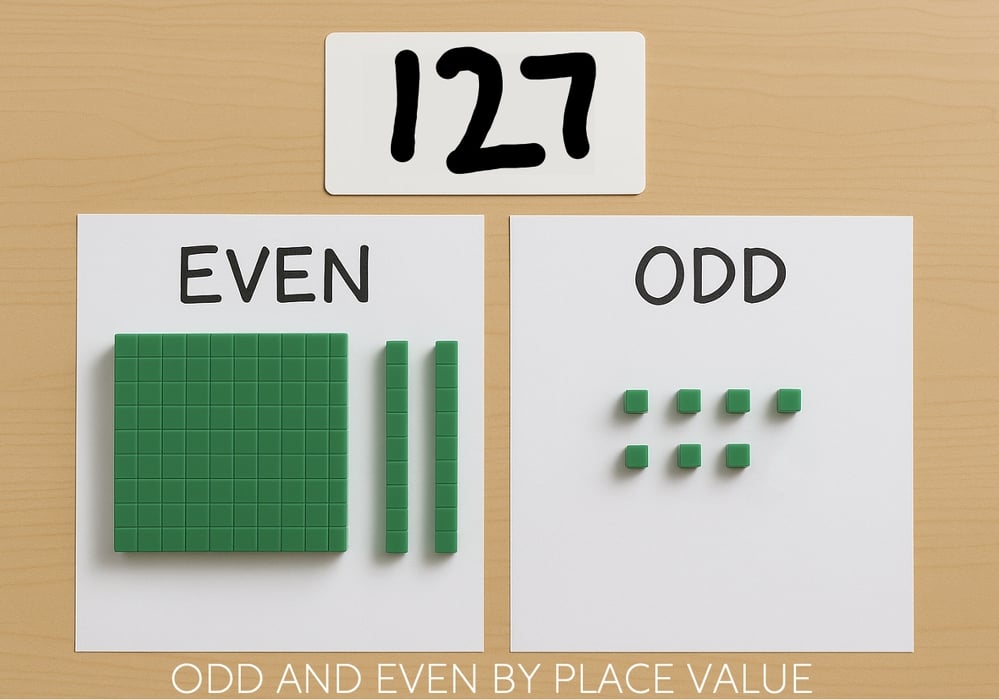
Be prepared to prove it a few times, using manipulatives or base-ten blocks. Let’s say you pick the number 38. Build 38 with tens rods and unit cubes. Hold up each tens rod, showing that it is made of an even number of cubes. Then set it aside. That leaves just the unit cubes left. Match them up to show they all have a partner. This proves that 38 is an even number.
Once your students get the idea, do the same with some 3-digit numbers. This is excellent for building number sense and understanding of our number system. You may have to spend a little more time on hundreds. Talk about how a hundred is made up of tens. So if ten is even, 100 must be too. Prove it with blocks and then talk about 200 and 300.
.
.
Why it works: This connects the physical pairing logic with the abstraction of place value. Kids realize they don’t need to re-pair every time — they can trust the system.
Teacher Tip: Some kids will get hung up on 300 (or 500, 700, etc.). If you show three hundred flats, they will want to match up the first two, leaving one hundred flat by itself. You may need to demonstrate that each hundred flat represents an even number. Just because there are 3 blocks (hundred flats) doesn’t mean 300 is odd.
Extension: If your school lunchroom uses long tables with kids on each side, use that to point out even and odd with a larger number. Once students are seated, point out how each person has a partner sitting directly across the table. Is there one person left without a partner or is everyone paired up? So does the class have an even or odd number of students?
.
4. Whole-Group Games
Here are a few quick whole-class games that will add some fun to your lesson plans and get kids thinking. They also double as brain breaks!
Odd and Even Corners
This is a variation on the “Four Corners” game kids love.
- Create a set of number cards (use index cards that aren’t see through). Write a number on the front and “even” or “odd” on the back.
- Label two corners of the room: Odd and Even
- Hold up a number card for everyone to see.
- Students walk to the corner to make their choice.
- Flip the card to reveal the correct answer.
- Students who chose the incorrect answer sit down.
- Keep playing until only one student is left.
.
.
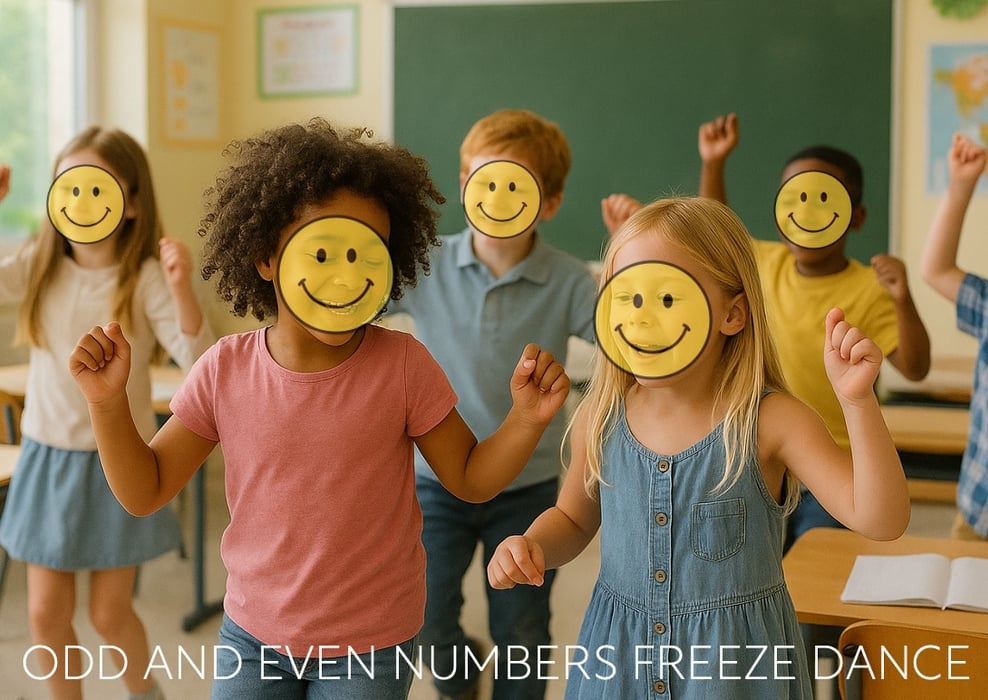
Even/Odd Freeze Dance
You can use the same set of number cards for this activity.
- Play some music and let students dance around the room.
- Stop the music and hold up a number card.
- If the number is even, students freeze with arms up.
- If the number is odd, they freeze crouched down.
.
5. Look for Patterns
Reinforce the idea that even and odd numbers occur in a predictable pattern.
- Count and Clap: Pick a starting number, then have students count forward, clapping on just the even numbers. Then do it again, clapping just on the odd ones. The rhythm makes the alternating pattern clear.
- Calendar Math: Circle even days in one color and odd days another. Make predictions about what tomorrow” will be.
- Hundred Chart: Give each student a number chart. Have them highlight odd numbers in one color and evens in another. The stripes will help kids see a pattern that you can relate to skip counting.
.

.
6. Math Read Alouds
I love using books to introduce new math concepts! There aren’t a whole lot of good read-alouds out there for even and odd numbers, but I have found a few I like:
.

One Odd Day is a really funny, rhyming story that younger students love. This is my favorite read-aloud for teaching odd numbers.
There’s a companion book for even numbers, but I don’t like it as much. It depicts a mom with two heads which can be kind of disturbing to sensitive younger kids.
.
Missing Mittens is part of the MathStart series that focuses on even and odd numbers. It’s good for an introduction to making pairs and best for first grade.

.
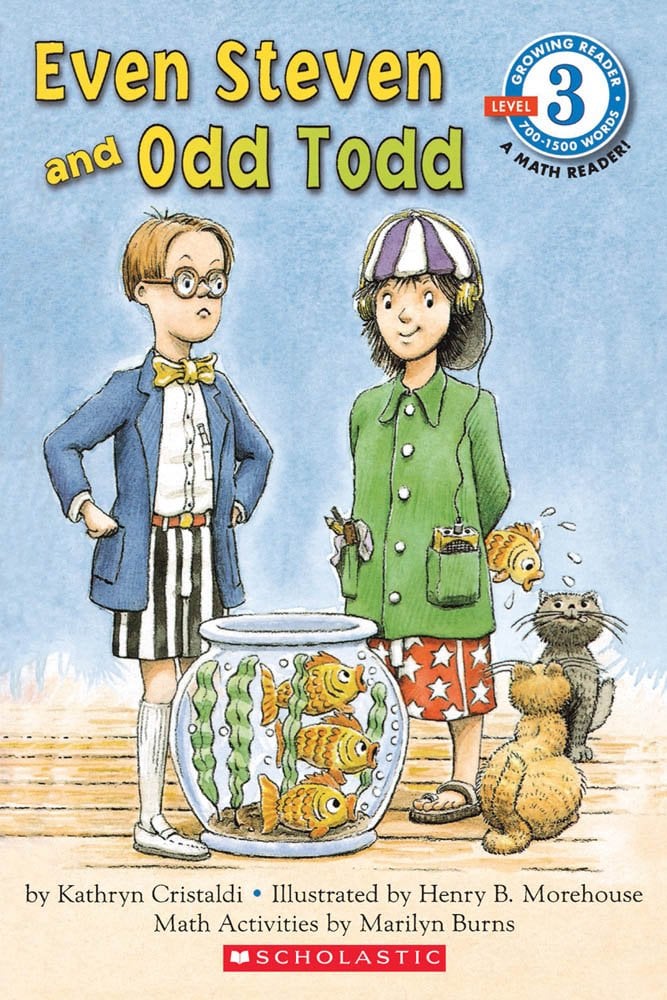
Even Steven and Odd Todd is a math reader that second graders can read independently. It also makes a fun read-aloud in first or second grade.
I like that it works in a lot of skip counting. Kids like to count along during those parts.
.
Do students get it?
Exit tickets work well to keep tabs on progress and mastery. Just give students a sticky note to jot down their answers. I like to do this right before a transition (like going to special or lunch). They can leave their post-its on their desks, and I can check them when I get back to the room. Correct ones get tossed in the trash. Incorrect get saved so I pull those kids during guided math for reteaching.
Here are some simple exit ticket prompts that give a quick snapshot of student understanding. (Some of these have blanks where you’ll need to fill in your own numbers.)
- Write down five even numbers
- Prove ___ is odd in two different ways.
- What is the closest even number that comes before ___? What is the closest odd number the comes after ___?
- Write all the odd/even numbers between ___ and ___.
- Complete the sentence “Odd numbers always _______________.”
- Complete the sentence “Even numbers always ______________.”
.
If most of the class doesn’t get it, bring back the manipulatives during whole group review. I love to use the Didax website for this. It has a great little tool with different virtual manipulatives that you can project for the class to see.
.
How to Teach Odd and Even Numbers Across Grades
- First Graders: Stay concrete with lots of hands-on object pairing and dot patterns, focus on numbers up to 20. Work in some read-alouds.
- Second Graders: Blend concrete with abstract. Use the ones place rule daily and connect to larger two-digit numbers. Start talking about equal groups as a foundation for multiplication.
- Third and Up: Touch back on odd/even briefly, but link it to divisibility, factors, and even prime numbers. Try quick mental math puzzles like, “Name all the odd numbers between 40 and 50 that are also multiples of 3.”
.
How to teach odd and even numbers isn’t brain surgery, but isn’t a one-and-done mini-lesson either. Give kids multiple access points and keep building on the concept until it becomes automatic. Try working it into your daily routine. Math journals are a great way to do this.
If you don’t have a formal “number of the day” packet that includes even and odd, it’s easy to do yourself:
Post a number on the board each morning or at the start of your math block. Have students evaluate it in their math notebooks or journals using a set of prompts:
- Write the number in expanded form and underline the ones
- Is the number odd or even? Prove it with a drawing.
- Add and subtract 1. Are those numbers even or odd?
.
Try a few of these strategies this week. You’ll be amazed how quickly your students start using the language of place value on their own.
.
Need more materials for teaching even and odd numbers? Here are few printable resources to work into your lesson plans:
Jake’s New Job is an interactive math story packed with even and odd numbers practice for 2nd grade. It’s fun, engaging, and perfect to use in your math centers!

.

Feed the Elephants is a simple even and odd sorting game for two players. Perfect for partner work!
Students take turns drawing number cards to “feed” to their even and odd elephants.
.