Some parts of teaching are just plain tricky, right? For me, it’s always been math facts. Getting a whole group of kids to actually remember them long-term feels like pulling teeth most days. And yet, I know how important it is. When students don’t have those basics down, everything else in math is so much harder. That’s why so many teachers have the same question: What’s the best way to teach math facts so they really stick?
So today, I want to talk about how to help kids achieve math fact fluency in a way that’s more fun than frustrating. I’ll share what’s worked in my classroom with a few fun twists you can try.
Oh, and hang on until the end – I’ve got a few free math facts color by number worksheets for you. They’re perfect for morning work, early finishers, or just sneaking in a little practice without all the groans and eye rolls.
.
.
Why Kids Need Math Facts in the First Place
You’ve probably seen this happen: a student is cruising along on a math problem, then suddenly gets stuck on something like 3 × 8. They freeze. By the time they finally work it out, they’ve completely lost track of the rest of the problem.
That’s the whole reason math fluency has to be a part of math education. If kids can quickly recall basic math facts, their working memory is free to focus on the parts that require real problem solving. Their brains don’t have to waste energy on the small stuff. They can actually think about the word problem or the fraction concept instead of stopping dead at “7 + 8.”
Without that fluency, math becomes frustrating, and when kids keep struggling, you know what creeps in – math anxiety and the “I’m not good at math” attitude.
But when kids start to build a strong foundation – whether it’s addition facts or multiplication tables – it’s a game-changer. Suddenly, they can solve more problems, take risks, and feel successful. That confidence is what keeps them moving forward.
But how do we get our young learners to that point?
.
What’s the best way to teach math facts?
.
Old Way vs. New Way
Remember when we were kids? Most of us learned math facts through drills, flash cards, and those dreaded timed tests.
Did it work? Sort of. Some of us learned everything through rote memorization. But others? Not so much. Those “mad minutes” caused more anxiety than actual learning, and the time pressure made math feel like punishment.
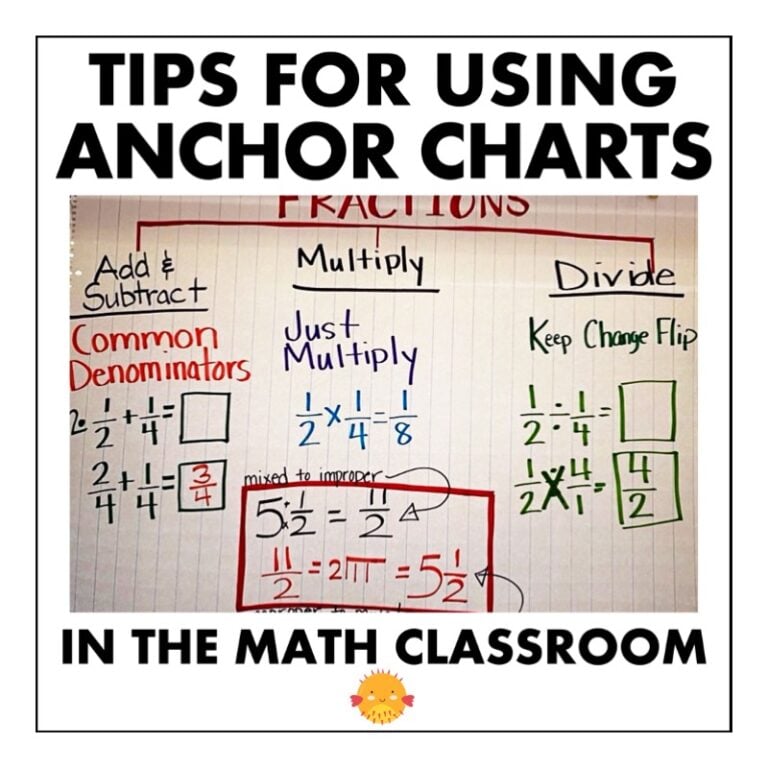
That’s why today, instead of relying only on drill, I mix in things like number talks, anchor charts, and hands-on games that specifically focus on math facts. It’s not just about memorizing – it’s about understanding.
Don’t get me wrong – we want to move those facts into long-term memory, but we also want kids to understand number relationships and have a few mental strategies up their sleeves. That kind of conceptual knowledge makes memorizing easier.
.
Let’s Talk Math Facts Practice
So, what does practice actually look like in real life? How do we work it into our already packed math block? Here are some of my favorite low-prep, low-stress options:
Flash Cards
I still use flash cards, but I put the kids in charge by letting them make their own on index cards. They feel so proud of their homemade flash cards, and just the act of writing them all down is actually giving them extra practice.
Sometimes I partner the kids up so one is the “quizzer” and the other is the “solver.” For some reason, they really love that, so it’s often one of my stations during math workshop.
.


.
Number Talks
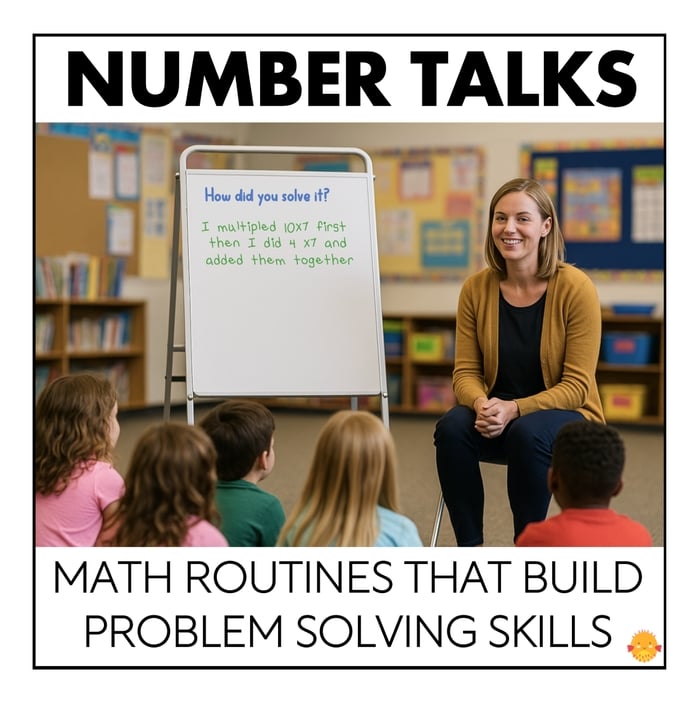
I love doing these as quick warm-ups. Kids share how they used mental math to solve a fact, and you hear all these cool math fact strategies you never thought of. For example, a kid might say, “I knew 9 + 6 was 15 because I moved one over from the 6 to make it 10 + 5.” It’s so simple, but it builds such solid number sense.
Read more about Number Talks
.
Games, Games, Games
Oh my gosh, math fact games are lifesavers and such a fun way to build math skills!
- A bingo game with subtraction facts gets the whole class engaged.
- Online games are great for independent work or early finishers.
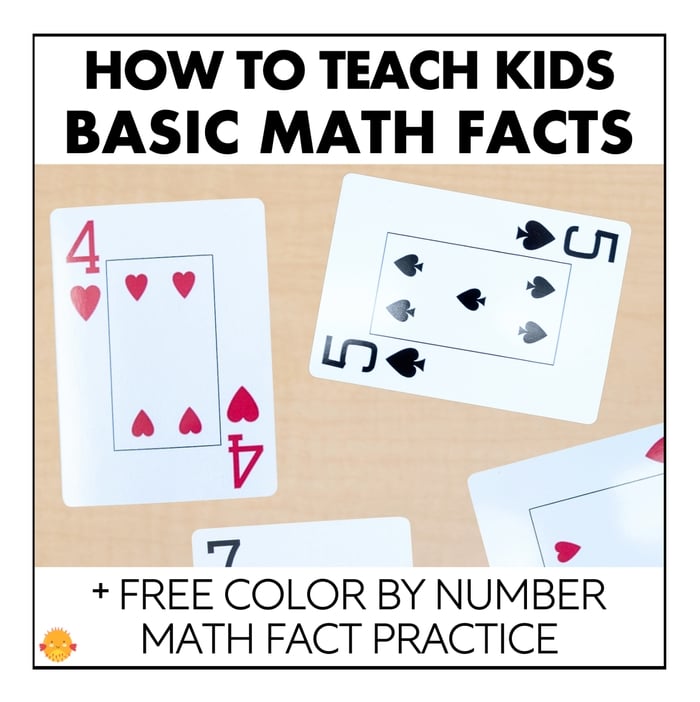
- Even a deck of cards works – you flip two cards and add, subtract, or multiply.
.
Kids don’t even realize they’re practicing math facts when it’s in the form of a game. They just think their amazing teacher is letting them do fun activities.
✅ My 3rd grade class’s favorite game of all time is what we call “Math Challenge” and we play it every week. It doesn’t require any materials at all. Here’s how to play:
- Divide the class into two teams. Line them up on opposite sides of the room.
- The first person in each line comes up to the board.
- Call out a math fact and they write the answer on the board as quickly as possible.
- The first one with the correct answer rejoins their line. The other player sits down.
- Keep playing until there is only one person left as the winner.
- When players get eliminated and sit down, they have to work out problems the problems on their whiteboards while the game continues.
- The winner gets a little trophy to keep on their desk until the next weeks’ game. 🏆
.
I use this game for learning multiplication facts, but it can be used for addition facts in 1st or 2nd grade or division facts for 4th grade math.
Another fun game to build fact fluency is math bingo. Call out or show students a math problem, and they mark the answer on their bingo board. Simple and effective!
.
Math Facts Bingo Games


.
.
Coloring Worksheets
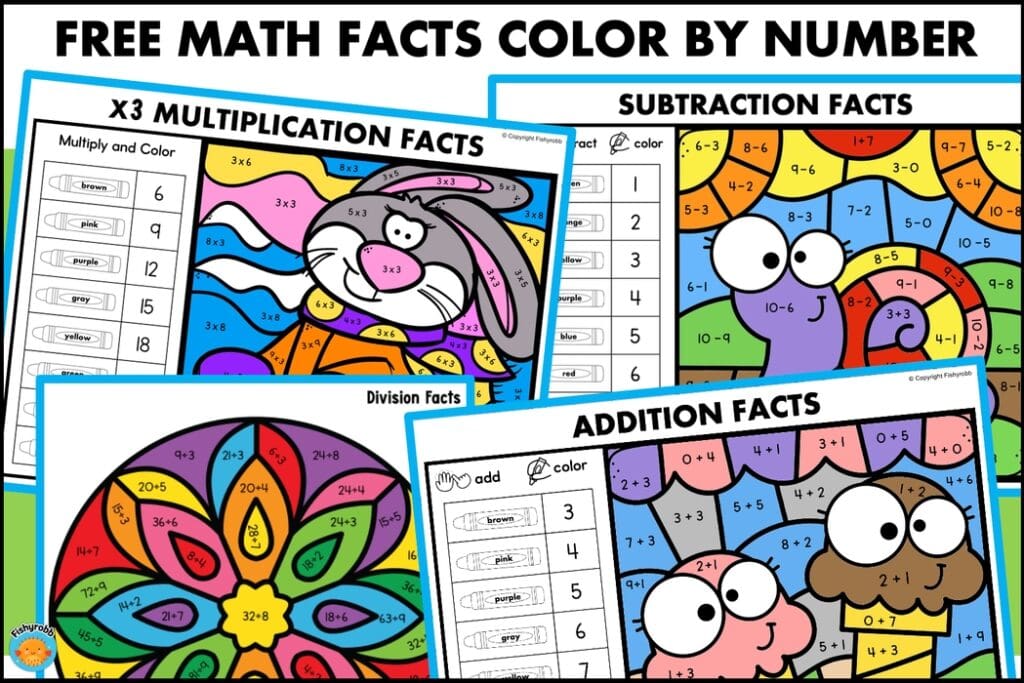
This is a sneaky one. Hand out color-by-number worksheets using math facts. The kids are so focused on coloring the picture, they don’t really care that they’re doing math. It’s practice in disguise, and it works. At the end of this post, I’ll have some free math facts color by number printables you can download.
.
Breaking It Down by Operation
Every operation comes with its own challenges. Here’s how I usually approach them:
- Addition Facts: Start with smaller numbers and build up. I love teaching the commutative property because it’s like magic. If they know 3 + 4 = 7, then they can figure out 4 + 3 just as easily.
- Subtraction: These make more sense when tied back to addition. Fact families are really important here. If you know 6 + 2 = 8, then 8 – 2 is less of a mystery.
- Multiplication: Times tables can feel a little bit scary, so I use skip counting, arrays, and number lines to make the patterns more obvious. I love showing my students how many facts they actually already know – the 0s and the 1s are automatic. With the commutative property, they automatically know the “flip flop facts” for the ones they’ve already memorized.
- Division Facts: Tricky for sure, but I always connect them straight back to multiplication. Fact families to the rescue again!
.

Kids should know their multiplication facts by the end of grade 3, but that’s often not the case. If you teach 4th, be sure to spend a good amount of time at the beginning of the year practicing them again.
If your students feel frustrated about how many facts they still don’t know, this sheet is a great help: How Many Multiplication Facts Do I Need to Learn? I’ve even used it with fifth grade intervention groups.
.
The Timed Test Debate
Ah yes, the famous one-minute test. Some teachers swear by them; others avoid them completely. Do I use them? Sometimes. But I just don’t make a big deal of it. Some kids relish the challenge, but others shut down the second they feel the time pressure.
If you do want to use timed math drills, here are a few things I don’t suggest – unless you want to ruin the lives of a few children (These are actual things from my daughter’s third grade year)…
- Do NOT punish your students for not passing their timed tests.
- Do NOT make them start over all the way back at their 1s when they don’t pass their 5s.
- Do NOT post a giant chart in your room with their names showing how many facts they do or do not know.
.
Here’s the secret to really learning those math facts: short, consistent practice sprinkled throughout the day. Not 30 minutes of drilling, but little bursts. Those little bits of daily practice add up. And before you know it, kids are rattling off facts without even thinking.
Every class is different, right? You might have one kid who knows all their facts in October and another who’s still stuck on 3 + 4 in March. That’s okay. We just have to adjust.
- Give struggling students more time with smaller numbers
- Let them use visuals like an anchor chart or a number line during practice.
- Encourage kids who are ready to build speed by playing against themselves—can they beat yesterday’s score?
- Give students who have already mastered their facts roles like running flash card drills or calling out problems during a game.
.
No matter what, celebrate their growth. Even getting two more problems correct during a timed math drill is great progress!
.
Free Math Facts Color By Number Worksheets
Okay, here’s the good part. I’ve put together some free math facts color by number worksheets for practicing math facts. Yep, totally free for classroom use. They’re perfect for:
- Independent practice
- Morning work
- Math centers
- Fast finishers
- Sub plans
- A little quiet down after recess 😅
.
These color by number pages are easy to pop right into your lesson plans, and I’ve got a few grade levels covered here. Kids solve the addition, subtraction, multiplication, or division problems, then color to reveal a picture. It feels like fun, but it’s a great way to fit in a little extra math fact practice – especially when students are tired of the same old-same old.
.
.
To grab this set of free printables, pop on over to the Resource Library. I’ve even included the answer keys for you because what’s the point if you can’t check their work?
If your students enjoy this type of color by code math, you can find more printable pages like this in my shop.
So, my friend, here’s what I’ve figured out: there isn’t just one best way to teach math facts. It’s really about balance and mixing it up. A little memorization, some mental math strategies, a few math fact games, and plenty of short, regular practice.
When we give kids different ways to learn, they build math fluency without all the stress – and who wants our little people to learn that math is a stressful thing? Not me!