I’ll be 100% honest – when I first heard about math number talks, it sounded like another one of those trendy edu-talk things that would be pushed down our throats during PD. I also didn’t want yet another “mandate” about how to teach. But I was willing to give it a shot, so I tried it with my class… and then I kept trying it… because it worked.
The very first number talk I did was with a room full of 2nd graders who had just come in from recess. They were sweaty and tired, so I sent them to sit on the rug for a little “math chat.” I wrote 26 + 59 on the board and said, “Solve it in your head.” There was complete silence – just a few death stares and one kid making that sound they make when you’ve asked them to do something ridiculous.
So, we had a little stare-down stand-off, and I just waited. Then slowly, kids started mumbling and counting on their fingers and I could actually see them thinking. It wasn’t long before they started calling out answers. To be truthful, it turned into kind of a free-for-all – not really what I was going for. But it was a start!
The next time we did a number talk, it was a bit more organized. I made them take turns talking. When one student gave an incorrect answer, I didn’t say anything. I just wrote it down on our chart paper and let the rest of the class debate whether it was right or not.
And just like that, something clicked. They realized there were different ways to get the same answer, and I realized there’s a better way to teach math. That’s how number talks became the foundation of math workshop in my class.
.
.
What Are Math Number Talks and Why Do They Work?
The purpose of number talks is pretty straightforward: build strong number sense and confidence in math by letting kids talk through their ideas together. But what they really do is create math thinkers, not just doers.
I’ve had students who could rattle off answers to math facts but couldn’t explain why they were correct. And I’ve had others who took forever to solve very basic problems because they didn’t understand the mathematical relationships that make it easy. Number talks address both ends of that spectrum.
This format lets kids:
- Practice using mental computation without relying on paper.
- Share different answers respectfully.
- Learn from incorrect answers without feeling embarrassed.
- Learn efficient strategies that make math easier.
- Change the culture of the classroom to one where math talk feels normal.
.
And honestly? Number talks make your job easier, too. You get to peek inside kids’ heads and actually see how (and if) they’re making sense of numbers. That is so useful when it’s time to plan your math lessons.
If that’s not enough…
- They’re short. Fit one in before recess or right after lunch.
- They’re flexible. Choose problems that fit whatever skills your class is working on.
- They’re revealing. You’ll learn more about your students’ thinking in ten minutes than you will from a whole unit test.
.
What Math Number Talks Look Like
If you’ve never seen one, a typical number talk is pretty straightforward.
I write a problem on the board. Since I teach multi-grade math intervention, it might be a dot card for kindergarten or a multiplication problem for 3rd grade. I ask the kids to solve it mentally—no paper, no pencils. I give them quiet think time. When they’re ready, they hold a thumbs up in front their chest (not waving it in the air) to let me know.
Then comes the best part: they explain.
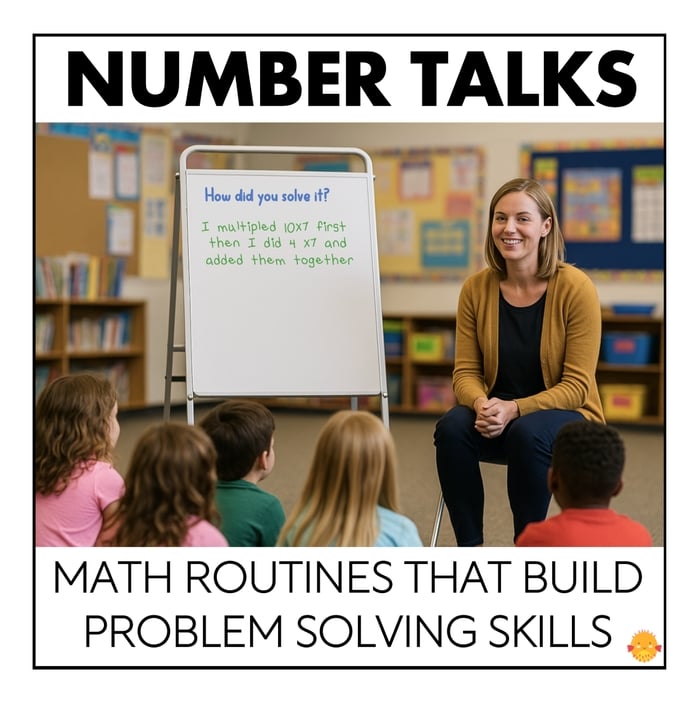
I call on one student, who gives their answer and explains their specific strategy. I record it exactly as they describe, even if it doesn’t match the “regular way” we all tend to use. Then another student shares, and another.
Soon we’ve got several different answers (usually) and a variety of ways to solve on the board. Sometimes the answers agree, sometimes they don’t. Either way, it creates great math discussions.
And I don’t rush to declare a “winner” or point out the “right way.” Instead, I ask questions like:
- “Who solved it a different way?”
- “Can someone explain what she said?”
- “Does anyone want to add on to that?”
- “Do we have enough information to solve it this way?”
.
The ultimate goal isn’t just the answer—it’s building understanding, confidence, and a culture where everyone feels comfortable sharing their ideas.
.
Math Number Talks In Different Grade Levels
One of the things I love most about math number talks is how they work with any grade level. The structure stays the same, but the problems change to match the skills and standards you need to focus on.
Kindergarten to 1st Grade
Number talks often focus on understanding small numbers and their values. You can use dot images or arrangements, five-frames, ten-frames, hundred charts, and number lines. Kids practice subitizing—instantly recognizing amounts without counting one by one—and start to see numbers as groups that can be broken apart and put back together. This is also a great time to work on mental math strategies for basic addition and subtraction.
In kindergarten, a number talk might be something as simple as showing two cards with dots (or a pair of dominoes or playing cards) and asking, “Which one has more?” The conversation that follows is all about how they were able to quickly recognize the number of dots and compare quantities.
.

.
Grab a free set of printable subitizing cards for numbers 1 through 12 from the Resource Library.
.
2nd Grade
Number talks in second grade shift toward building mental computation strategies and regrouping.
You might present a problem like 36 + 48 and ask them to solve it mentally. This invites kids to use place value or compensation strategies like “I took 2 from 36 and gave it to 48 to make 50 because it’s easier to add.” These talks let them practice manipulating whole numbers in ways that are hard to duplicate with a worksheet.
3rd, 4th Grade, and 5th Grade
With upper elementary students, math number talks start to focus on bigger challenges like multi-digit multiplication and division, fractions, and volume.
In third grade, I might pose a multiplication problem like 6 × 14. Even though this is technically beyond what we teach in third, kids can figure it out using different strategies—breaking it apart into 6 × 10 and 6 × 4, or doubling 6 × 7.
I really like to use numberless word problems with upper grades to get them to slow down and focus on the mathematical ideas before plugging in the numbers. During a number talk, you can read out a numberless word problem and ask them questions like, “What information do you need to solve this problem?” or “What would be your first step to figure this out?”
.
Using 3-Act Tasks as Number Talks
If you’ve ever tried a 3-act task, you know how great they can be. Well, they are amazing for math number talks! Show kids an interesting photo, video, or scenario, and then listen to what they notice and wonder about it that could be turned into a math problem. Their wonderings become your number talk classroom discussion.
Here’s how I like to do it:
Act 1 — The Hook
Instead of just writing a problem on the board, I show a short photo or video clip. Maybe it’s a jar of Skittles, a stack of cups, or a ball bouncing. I don’t give them all the details yet. I just ask, “What do you notice? What do you wonder about it?”
Act 2 — The Information
Once students share their questions, I give just enough information for them to solve something. For example, with a cup stacking video, I’ll tell them the height of one cup. That bit of information is enough to get them thinking about how tall the entire stack is or how many cups would it take to reach the ceiling? (Remember, they come up with their own questions.) This where the number talk comes in. Students share different answers and the ways they came up with them.
Act 3 — The Reveal
Finally, we check against the actual answer—either the end of the video or the “big reveal” slide will give it away. Kids get so excited to see if their ideas matched reality.
The great thing about 3-act tasks is that they can be adapted to any grade level and don’t need to take up your entire whole group time. When I use a 3-act task as a math number talk, I keep it short (remember, 5–15 minutes).
If your routine number talks are starting to feel a little bit stale, 3-act tasks are a great way to add some variety, and kids really do love them.
For more ideas about using 3-act tasks in your classroom, see: 3-Act Task Fraction Lessons
.
What About Mistakes and Incorrect Answers?
One of the best things about math number talks is how they completely change the way mistakes feel in the classroom. Usually, if a student blurts out an incorrect answer during class, the room goes quiet, and that child shuts down or is completely embarrassed. But with number talks, mistakes aren’t the end of the road—they’re just part of the conversation.
What I’ve noticed is that when kids realize mistakes won’t embarrass them, they take more risks. The quiet kids are more willing to speak up. The speedy ones slow down and think carefully about how to explain their strategy so others can follow it. After a while, our “math meeting” (as I call it in my room) becomes a safe space. That makes me really happy!
.

.
Getting Started with Math Number Talks
If you haven’t tried a number talk yet, tomorrow’s the perfect day! Here’s a little cheat sheet with some key components of number talks to help you get started:
- Keep it short. Remember: 5–15 minutes is ideal.
- Write down every answer, even incorrect answers.
- Highlight efficient strategies, but don’t dismiss the others.
- Be consistent. Like any daily routine, the more you do it, the better it works.
- Teach kids to listen to each other, not just to you.
.
The first time you do this, it might feel a little bit unstructured and weird. But stick with it. I promise it will make a difference in how your students feel about math. I’ve seen students scared of math transform into leaders during number talks. That’s why I believe in them so much.
If you’re looking for a great book on number talks to do an book study at school, check out these titles by Sherry Parrish: